
S’pore should be enabler of AI solutions at scale, not compete on building frontier models: Committee
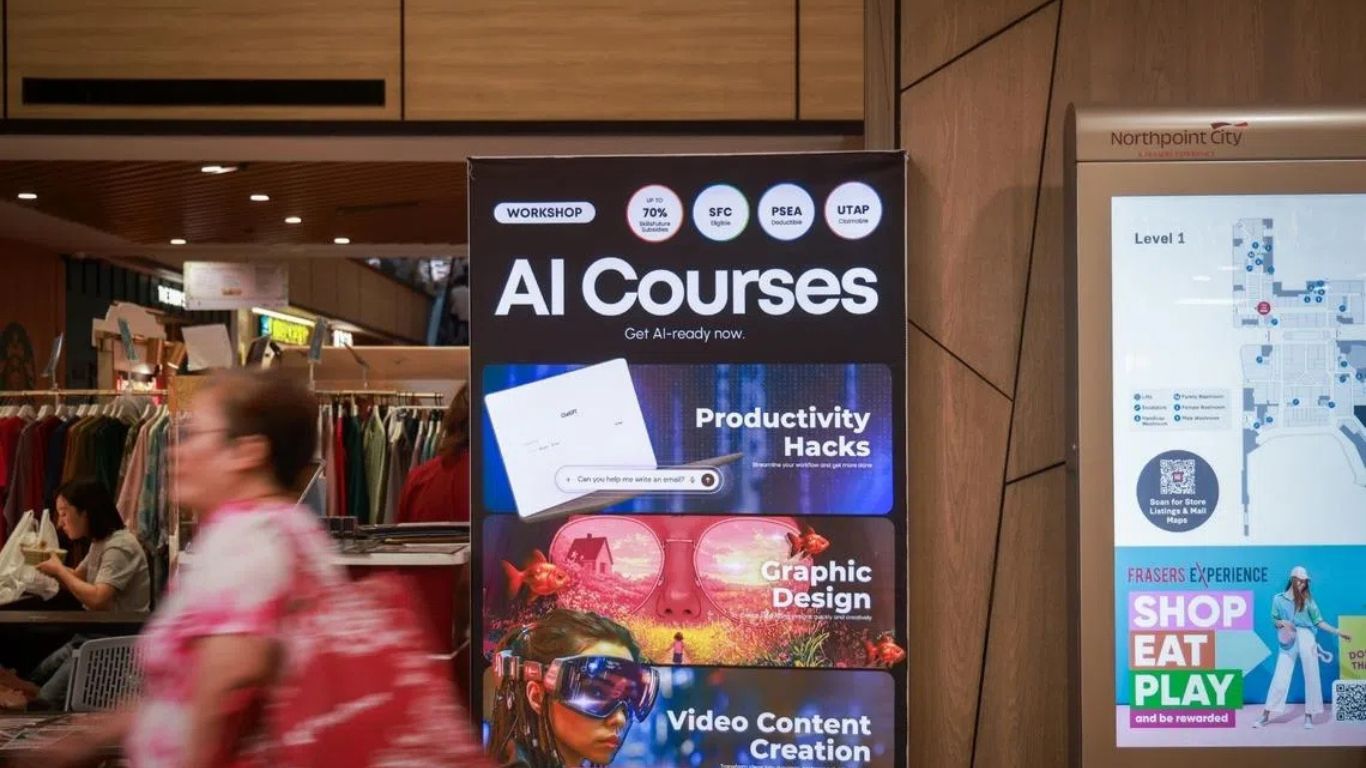
The Economic Strategy Review committee noted that AI should be integrated across firms’ operations and workforce capabilities. (PHOTO: ST FILE)
Source: The Straits Times
Singapore can position itself as one of the best places in the world to develop, test and deploy AI solutions that solve real-world business problems.
This was among a slew of recommendations by the Economic Strategy Review (ESR) committee to make the Republic an AI-empowered economy and a global leader in AI solutions, which is the second of eight thrusts aimed at driving the country’s economic growth and workforce transformation.
Comprising five sub-committees, the committee was formed in August 2025 to study how Singapore can remain competitive amid geopolitical changes.
It noted that even as artificial intelligence is set to reshape economies as earlier innovations such as the internet did, Singapore does not have the scale of larger economies.
Rather than compete to build the biggest frontier AI model or host the largest AI data centres, Singapore should instead position itself as “a trusted hub where AI solutions are developed, tested and deployed to tackle real-world problems at scale”.
“Our advantage lies in our ability to bring together government, industry and research institutions to channel resources and create the most enabling environment for breakthrough innovation,” the committee added.
The committee noted that, based on earlier ESR recommendations, the Government had established the National AI Council (NAIC) to drive the country’s national AI strategy, with national AI missions across four areas – advanced manufacturing, finance, healthcare and logistics.
Additionally, it recommended several other measures, including making the city-state a location of choice for high-impact AI solutions, with the NAIC working with businesses to co-develop “ambitious sector-specific” problem statements suited for the deployment of the technology.
The country should mobilise resources such as data sets and data infrastructure to attract leading AI companies and talent so as to develop and deploy solutions, which should eventually be scaled beyond the pilot stage and rolled out internationally.
“We should also update our rules for AI governance and invest in AI safety capabilities, so that Singapore becomes a trusted environment for responsible AI innovation,” the committee said.
The committee noted that AI should be integrated across firms’ operations and workforce capabilities – a task which requires significant changes to systems, workflows and business models, and carries risks such as cybersecurity and operational vulnerabilities.
It recommended that tailored support should also be offered to leading Singapore-based firms to help them undertake full-scale AI transformation, build new capabilities and manage these risks.
These companies could then serve as reference models for their respective industries, it added.
It also recommended accelerating AI adoption across the economy, noting that many small and medium-sized enterprises (SMEs) face challenges such as capability and cost constraints, as well as limited access to sufficiently large, high-quality data sets to develop AI solutions effectively.
“Smaller firms also still find it hard to navigate and access existing government support schemes,” the committee said.
It noted that trade associations and chambers could play a stronger coordinating role to aggregate demand, pool data where appropriate and work with AI developers to create shared, sector-level solutions that can be deployed across firms more easily.
“Initial efforts can focus on sectors where there is strong potential for common AI use cases and wider productivity gains,” it said.
Senior Parliamentary Secretary for Sustainability and the Environment Goh Hanyan described AI as a “very powerful technology” that lends itself to huge experimentation.
Top-down direction is needed as large-scale adoption of the technology requires culture change and “empowerment at different levels”, said Ms Goh, who co-chairs the ESR sub-committee on technology and innovation.
“It is not simply an enterprise productivity tool that can just be rolled out,” she said during the Singapore Business Federation’s Future Economy Conference 2026 on May 13.
Noting that adoption of the technology is lagging, she said training can help expose more to the technology so as to better understand it.
Ms Goh, who is also Senior Parliamentary Secretary for Culture, Community and Youth, suggested that such training could be made more widespread or even mandatory among staff of companies looking to adopt AI.
Yong Kang TCM Clinic said Enterprise Singapore’s Productivity Solutions Grant was instrumental in its adoption of an AI chatbot, which resulted in faster responses to customers and a 20 per cent increase in bookings.
“The support provided by the Government made it more practical for us to test and adopt new technologies while improving our customer engagement processes,” said Yong Kang’s business development executive Leo Loh.
“As an SME with operations across multiple South-east Asian countries, we hope to see greater support for cross-border AI expansion, whether through bilateral initiatives, shared regulatory guidance or grant frameworks that can better support regional business growth beyond Singapore,” he added.
Mr Leonard Loo, the CEO of agentic AI solutions firm Voltade, said that Singapore was well-placed to become a “trusted hub” for AI solutions.
As a neutral party between tech giants in the US and China, the Republic could help develop common governance guidelines for various AI models worldwide, he suggested.