
S’pore to invest $800 million in transport research and innovation over next five years
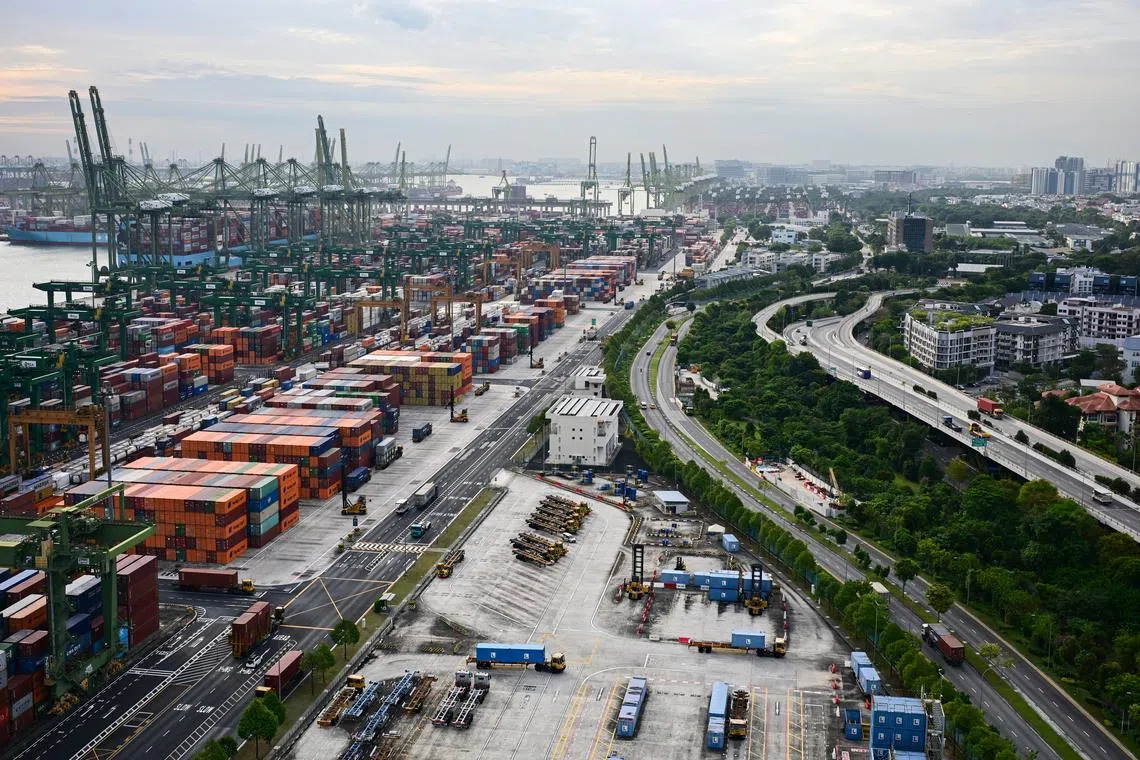
About two-thirds of the funding will go towards improving capabilities in two areas: autonomous systems and digital twins to improve connectivity. (ST PHOTO: LIM YAOHUI)
Source: The Straits Times
Some $800 million will be pumped into the transport sector over the next five years to strengthen Singapore’s position as a global transport and logistics hub.
Announcing the funding on July 7, Acting Transport Minister Jeffrey Siow said: “We will use these funds to back ideas that could completely transform how transport operates today.”
He cited examples such as a fully automated depot that allows for more efficient maintenance and repairs of trains, a smart port network and an AI-enabled air traffic management system that increases regional airspace capacity.
The minister was speaking during the debate on a motion moved by PAP MP Tin Pei Ling, who chairs the Government Parliamentary Committee for Transport.
In all, 24 MPs spoke and gave suggestions to improve Singapore’s position as a global transport hub. After more than six hours of debate, the House unanimously supported the motion.
The $800 million funding falls under the National Research Foundation’s Research, Innovation and Enterprise (RIE) 2030 plan. It will build on earlier research efforts that cut across the air, land and maritime sectors, said the Ministry of Transport (MOT).
About two-thirds of the funding, or $530 million, will go towards improving capabilities in two areas: autonomous systems and digital twins to improve connectivity.
A digital twin is a virtual model of a physical asset or system that uses real-time data to mirror its condition and performance, allowing it to be monitored, analysed and tested digitally.
MOT said the aim is to harness autonomous systems, artificial intelligence and robotics across the logistics network, port and airport to enable operations that are large-scale, safe and manpower-light.
This will include drawing up new testing and certification frameworks for autonomous vehicles and unmanned aircraft.
Joining the debate, Minister of State for Transport Baey Yam Keng said the Government will invest in digital twin models to manage the transport network more effectively.
The integration of relevant data across the port, airport and logistics network can be used to improve cargo movements in logistics hubs.
In road traffic management, disruptions can be identified and addressed earlier, and weather conditions can be forecast ahead of time to reduce the impact on airport operations.
The remaining third of the funds – more than $260 million – will support research in the land, aviation and maritime sectors.
For land transport, research will focus on autonomous public transport and automated rail depots.
With fast-evolving rail technology, researchers will focus on upgrades aimed at boosting reliability and reducing maintenance needs, MOT said. AI and sensors will also be used to help forecast maintenance needs and automate some of the maintenance tasks at rail depots.
In aviation, the research will be on ways to help Singapore’s air hub cope with growing passenger numbers and cargo demand. AI will be used to optimise flight movements, reduce flight times and emissions, and support air traffic controllers.
On the ground, AI and automation will be used to help workers with physically demanding tasks such as baggage handling, and improve the passenger journey from kerbside to gate.
For the maritime sector, research will focus on autonomous port operations, alternative fuels, smart ships and integrated port services. As Singapore handles more vessels while facing tighter constraints on sea space and manpower, better coordination of port activities will become increasingly important, MOT said.
In her speech to move the motion for debate, Tin had highlighted three key areas to strengthen Singapore’s long-term economic competitiveness: strengthening international cooperation, harnessing frontier technologies such as AI, and integrating physical and digital infrastructure.
“Together, they serve one ultimate goal: generating and anchoring meaningful jobs for Singaporeans to take up and grow in,” she said.
Tin noted that recent geopolitical shocks have highlighted the need for the Republic to remain connected even during major disruptions.
Developments around the Strait of Hormuz have made the world more reliant on the Strait of Malacca, creating both opportunities and risks for Singapore, she added.
Singapore must have the capacity and capability to handle rising trade flows, which will require closer cooperation with regional neighbours, she said.
One suggestion she made was for the Government to prioritise land, air and sea connectivity within ASEAN, and build a shared digital transport network that would allow countries to securely share data to support cross-border transport and innovation.
Responding to MPs in his speech, Siow reiterated his ministry’s priorities for the transport sector, which he first set out in March: to be globally oriented, future-focused and people-centric.
Citing the closure of the Strait of Hormuz, which disrupted global energy and supply chains, he noted that there were even suggestions that countries could levy tolls, as though the right of transit passage under the United Nations Convention on the Law of the Sea simply did not exist.
“For most countries, these are distant headlines. For Singapore, this is existential,” he said, adding that Singapore depends on a rules-based international order “where every nation, large or small, operates on the same terms”.
This is why Singapore spoke up on the Strait of Hormuz, Siow said. “For a country that lives by its connections, these rules are a matter of survival.”
He added that Singapore’s presence in international organisations such as the International Maritime Organisation is one part of this strategy to be globally oriented, while its international partnerships are another.
Singapore has built a network of air services agreements, green and digital shipping corridors, and other partnerships. These agreements help explain why Changi Airport has flights to more than 170 cities today, while Singapore’s ports connect to over 600 locations worldwide, he said.
“We will deepen these links and build new ones with like-minded partners – bilaterally and multilaterally. This includes new initiatives with our ASEAN neighbours,” Siow said, noting that Singapore will chair ASEAN in 2027 and have the opportunity to advance projects that bring the region closer together.
As supply chains become more digital, connectivity will increasingly depend on technology, Siow said.
Turning to AI, he said the technology will profoundly reshape Singapore’s economy and society, and the transport sector will be no exception.
“Our approach will not be to adopt AI for its own sake, but we will do so with intention, clarity and on our own terms,” said Siow, who leads the AI Missions on Connectivity, one of four national missions.
These AI missions are industry-centric by design, he noted, using AI to address real industry problems. This approach suits the transport sector especially well, he added.
Transport must also be people-centric, Siow said. On the economic front, this means helping workers become more productive and equipping them with new skills.
Acknowledging concerns from cabbies and private hire drivers about autonomous vehicles, Siow stressed that driver jobs will not vanish any time soon.
Many human drivers will still be needed even in 10 years’ time, he said, adding that his ministry will take a proactive approach to support drivers through any transition.
Senior Minister of State for Transport Sun Xueling announced several measures on July 7 to help taxi and private hire drivers reskill and explore new career opportunities. These include a new incentive scheme to defray vehicle rental fees and lost income while drivers undergo training.
Concluding his speech, Siow said the future of transport will ultimately centre on people and provide future generations with opportunities.
“We hold the line on the rules so that a small nation is never left at the mercy of a larger one. We invest at the frontier so that our hard-won lead is not quietly surrendered. We do all of it for one reason and one reason only – for Singaporeans,” he said.