
Singapore’s Q2 growth eases to 5.7% as Iran war tempers AI-powered manufacturing growth
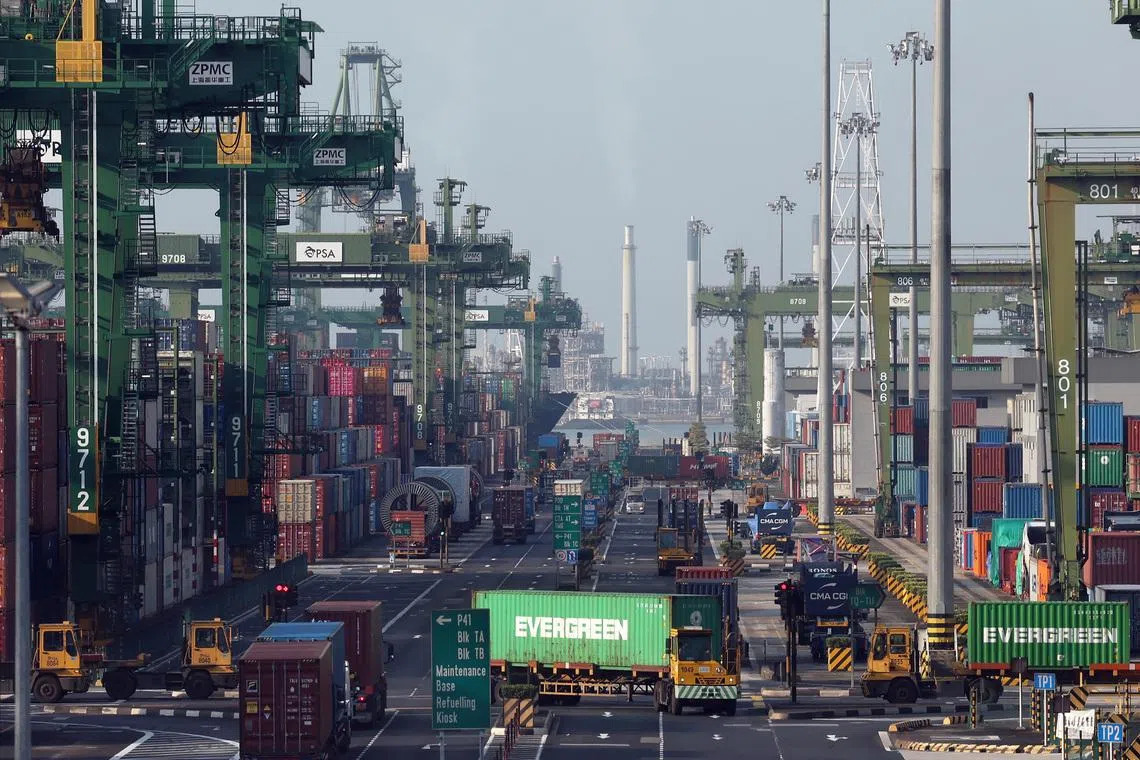
Singapore’s wholesale and retail trade, along with the transportation and storage sectors, collectively grew by 6.3 per cent in the second quarter, moderating from the 9.3 per cent growth in the previous quarter. (PHOTO: ST FILE)
Source: The Straits Times
Singapore’s economy continued to benefit from the AI boom, but grew at a slower pace in the second quarter of 2026 as expansion in construction and wholesale trade eased.
The Ministry of Trade and Industry (MTI) said the economy expanded 5.7 per cent on a year-on-year basis in the April to June period, slower than the 6.3 per cent growth achieved in the previous quarter.
On a seasonally adjusted quarter-on-quarter basis, the economy expanded by 1.1 per cent – weaker than the first quarter’s 1.3 per cent growth.
The slower pace of expansion was mainly due to sectors such as construction, which expanded by 6.2 per cent year on year in the second quarter, compared with 12.9 per cent in the previous quarter.
MTI said wholesale and retail trade, along with the transportation and storage sectors, collectively grew by 6.3 per cent in the second quarter, moderating from the 9.3 per cent growth in the previous quarter.
The manufacturing sector, however, continued to record robust expansion, growing 12.2 per cent year on year, accelerating from the 8 per cent expansion in the previous quarter.
MTI said manufacturing during the quarter was largely driven by output increases in the electronics and precision engineering clusters because of strong AI-related demand for semiconductors and semiconductor manufacturing equipment respectively.
Within manufacturing, the chemicals and biomedical clusters contracted, due to feedstock disruptions arising from the conflict in the Middle East.
On a quarter-on-quarter seasonally adjusted basis, the manufacturing sector grew by 5.3 per cent, a turnaround from the 2.2 per cent contraction in the first quarter.
Singapore’s non-oil domestic exports expanded by 38.4 per cent in May compared with a year earlier, extending April’s 24.4 per cent rise as strong AI-related demand continued to drive trade momentum.
Most analysts believe it would be difficult to outperform the pace of growth the Singapore economy recorded in the first quarter unless the volatile energy markets calm down.
The economic outlook has grown even more uncertain after the recent flare-up of hostilities between the US and Iran, putting at risk the 60-day ceasefire they agreed upon in mid-June.
Crude oil prices, which had dropped to a low of US$71 a barrel after the ceasefire deal was announced, have rebounded to levels above US$80 a barrel. However, they are still far from the peak of US$120 touched weeks after the US and Israel attacked Iran in late February.
Natural gas prices, which are benchmarked to oil, have pushed up electricity tariffs in Singapore.
The Middle East conflict has also led to shortages in crude oil and petroleum products such as petrol and diesel, contributing to contractions in the fuels and chemicals segment of the wholesale trade sector and the chemicals cluster of the manufacturing sector.
Since the outbreak of war, oil prices have surged and supply chains are in disarray with the closure of the Strait of Hormuz – through which 20 per cent of the world’s oil consumption used to pass – dampening the outlook for trade-dependent economies across Asia, including Singapore.
Sheana Yue, senior economist at UK-based advisory firm Oxford Economics, said while AI-related exports are set to remain the key growth driver, lagged Middle East conflict spillovers and uncertainty surrounding energy and freight cost will likely moderate second-half domestic demand and momentum.
“These lagged effects typically weigh on household spending, business investment and transport- and trade-related services in the coming quarters. That said, AI demand and Singapore’s embeddedness in regional supply chains should keep exports as the primary growth engine,” she said.
MTI had earlier said the conflict has also affected the global economic outlook, with disruptions to the supply of energy and other key inputs, such as fertiliser and aluminium, amid the blockade of the strait.
Core inflation – which excludes private transport and accommodation to better reflect household expenses – came in at 1.4 per cent in May, unchanged from April. But economists have warned that higher energy costs are expected to raise production and transport costs for a wide range of imported goods and services over time and weigh down the outlook for growth.
US President Donald Trump said on July 13 that the United States would resume a blockade on Iranian vessels transiting Hormuz and charge all other cargo a 20 per cent reimbursement fee. The latest wave of attacks between the US and Iran have dashed hopes for an early normalisation of traffic through the waterway.
Oxford Economics expects the Singapore economy to expand by 3.4 per cent in the whole of 2026. This forecast is at the higher end of MTI’s estimate of 2 per cent to 4 per cent growth.