
Singapore upgrades 2026 key exports growth forecast as AI-related demand surges
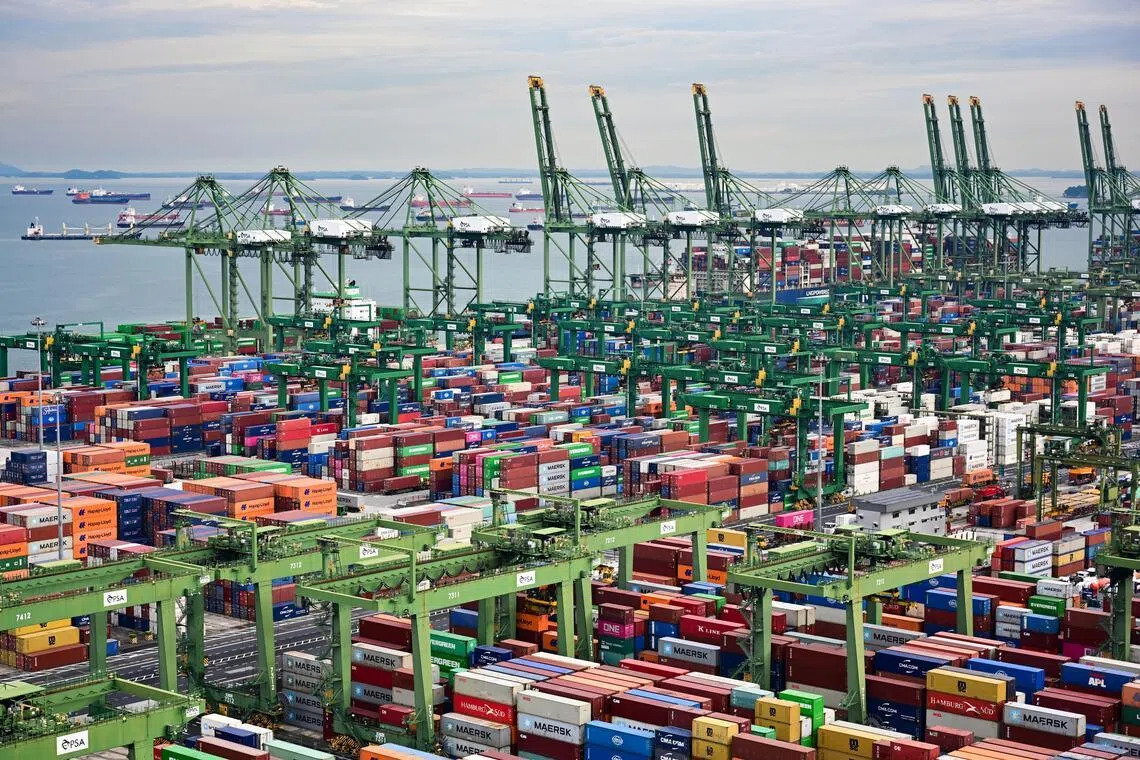
The first quarter of 2026 saw a 57.8 per cent surge in electronics shipments, driving overall key exports up 9.6 per cent. (ST PHOTO: LIM YAOHUI)
Source: The Straits Times
Singapore upgraded its key exports growth forecast for 2026, as strong artificial intelligence-related demand is expected to support electronics shipments despite higher downside risks from the Middle East conflict.
Enterprise Singapore now expects non-oil domestic exports (NODX) to rise by 3 per cent to 5 per cent in 2026, compared with its earlier forecast of 2 per cent to 4 per cent.
The stronger forecast is underpinned by the better-than-expected export performance in the first quarter, especially in electronics, EnterpriseSG said in its quarterly review on May 25.
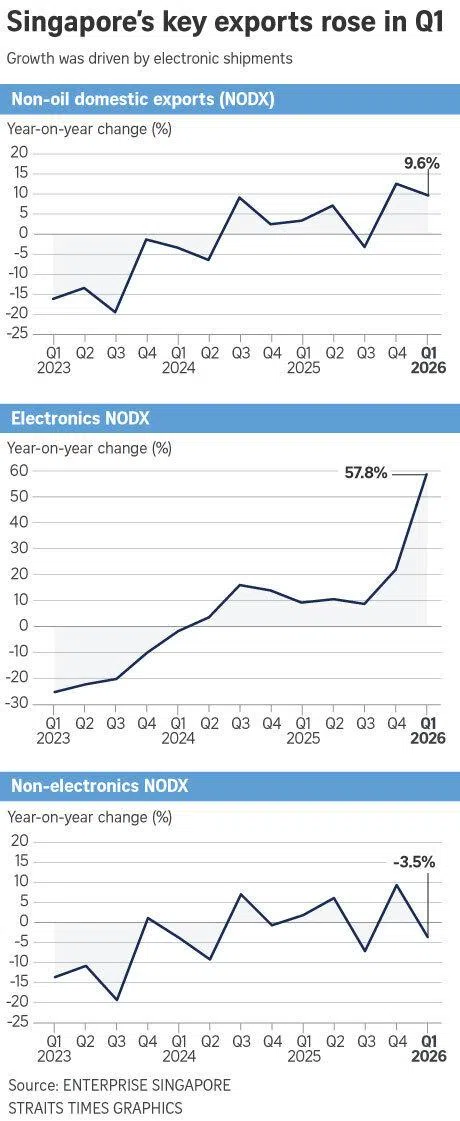
NODX rose 9.6 per cent in the first quarter of 2026, after climbing 12.7 per cent in the fourth quarter of 2025.
Electronics shipments surged 57.8 per cent, accelerating from the 23.4 per cent growth recorded in the previous quarter. However, non-electronics NODX declined by 3.5 per cent in the first quarter, reversing the 9.4 per cent growth in the fourth quarter of 2025.
NODX to the top 10 markets grew as a whole in the first quarter, driven by Taiwan, Hong Kong and South Korea.
Economists expect NODX growth to remain solid in the next few months, driven by electronics demand.
Maybank economist Brian Lee said Singapore’s NODX forecast upgrade was not surprising, given the better-than-expected export performance in the first quarter.
DBS Bank senior economist Chua Han Teng noted that global AI tailwinds – driven by robust capital expenditure intentions amid the shift towards agentic AI usage – will likely continue supporting external demand for Singapore’s memory chips and server-related products.
Agentic AI refers to autonomous AI systems that can achieve specific goals with minimum human supervision.
Mr Lee noted that the AI capex boom will likely be sustained into the second half of 2026, with US hyperscaler tech firms ramping up capex guidance further in the latest earnings season.
Mr Chua said: “The city-state has benefited indirectly from its integration into the AI ecosystem, with robust electronics exports momentum to upstream players such as Taiwan, a major beneficiary and strategic player in the AI supercycle.”
Despite helium supply disruptions linked to the Middle East conflict, semiconductor manufacturers have maintained production using existing inventories and recycling efforts, he noted. Helium is used to cool semiconductor wafers during production.
Still, key downside risks include rising costs and tighter financial conditions, he added.
EnterpriseSG said that since the last update, the global economy has remained more resilient than expected, supported by robust AI-related demand.
It noted that the World Trade Organization (WTO) upgraded its global merchandise trade volume growth forecast to 1.9 per cent in 2026, from 0.5 per cent previously, reflecting continued strength in AI-related trade and a smaller-than-expected drag from tariffs.
The International Monetary Fund (IMF) has raised its global trade volume growth forecast to 2.8 per cent, from 2.6 per cent previously.
The updated forecast remains consistent with the IMF’s and WTO’s projections of “softer growth in global trade volumes in 2026, while also factoring in high base effects in the latter half of the year”, said EnterpriseSG. “Downside risks include a prolonged conflict in the Middle East and a potential re-escalation of trade tensions.”
Domestically, a strong double-digit net weighted percentage of firms – particularly in the electronics and precision engineering clusters – expect improved overseas deliveries in the second quarter of 2026, at 43 per cent and 49 per cent respectively, the government agency noted.
Overall, business sentiment in the manufacturing sector for the next six months improved from the previous quarter, it said.
The upgrade comes as the Ministry of Trade and Industry said on May 25 that Singapore’s gross domestic product growth forecast for 2026 has been maintained at 2 per cent to 4 per cent, although downside risks have risen significantly as a result of the Iran war.
In the first quarter of 2026, Singapore’s economy grew 6 per cent year on year, extending the 5.7 per cent expansion in the previous quarter.