
Singapore lifts 2026 growth forecast to 2%-4% on AI outlook after economy outperforms in 2025
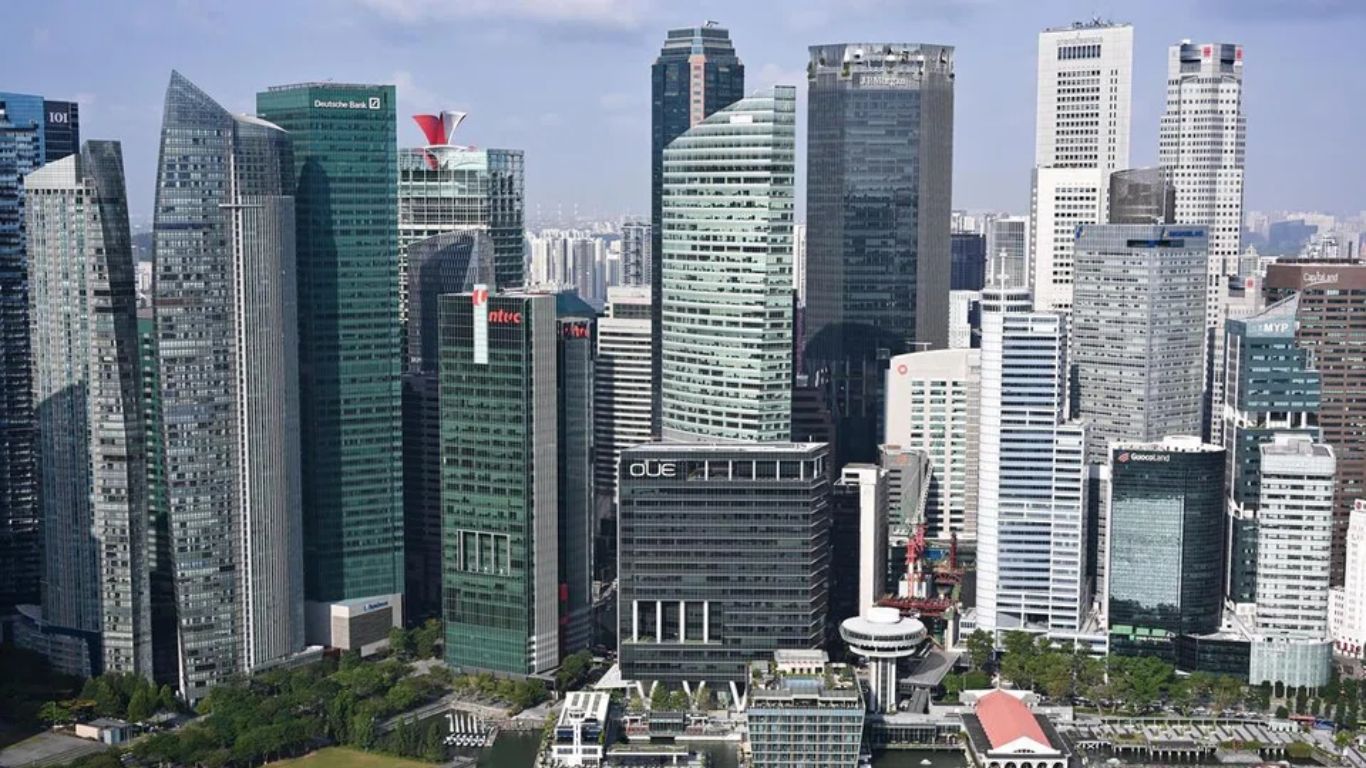
(Photo credit: ST Photo/Lim Yaohui)
Source: The Straits Times
Singapore upgraded its full-year 2026 growth forecast to a range of 2 per cent to 4 per cent after the economy grew much stronger than expected in the final quarter of 2025.
The growth outlook has been raised from an earlier range of 1 per cent to 3 per cent, with the economy projected to continue benefitting from a global AI investment boom.
The Ministry of Trade and Industry (MTI) also said the economy grew 5 per cent in 2025, higher than its earlier estimate of 4.8 per cent made in January.
The upgrades come after growth surged 6.9 per cent year on year in the fourth quarter of 2025, up from an earlier estimate of 5.7 per cent, beating the 4.6 per cent expansion in the third quarter.
On a seasonally adjusted quarter-on-quarter basis, the economy grew 2.1 per cent in the fourth quarter, moderating from the 2.6 per cent expansion in the third quarter.
The 5 per cent growth for 2025 is a step down from 2024’s revised 5.3 per cent expansion. The 2024 growth figure was raised from a previous estimate of 4.4 per cent. The last time the economy grew faster than that was in 2021, when it rebounded from the Covid-19 pandemic with a 9.8 per cent growth rate.
MTI said 2025 growth was mainly driven by the manufacturing, wholesale trade and finance and insurance sectors.
Strong AI-related electronics demand, powered Singapore’s electronics cluster with the manufacturing sector and the machinery, equipment and supplies segment of the wholesale trade sector.
The boom in AI-related demand saw Singapore
raise its forecast for key exports
on Feb 10. They are now expected to grow 2 per cent to 4 per cent in 2026, up from the previous forecast of 0 per cent to 2 per cent.
Most analysts believe the momentum from the AI capital expenditure boom will continue, with some of the world’s top tech firms announcing plans last week to invest more than US$660 billion (S$835 billion) in 2026 in AI-related infrastructure, assuring demand for electronics hardware such as semiconductors - which is a key Singapore export.
Mr Augustin Lee, the MTI’s permanent secretary for energy and trade, said the stronger-than-projected upswing in the AI investment cycle could provide a greater boost to electronics demand.
However, he added that this outlook is subject to downside risks as well.
“A renewed escalation in tariff actions or flare-ups in geopolitical tensions could lead to a resurgence in economic uncertainty,” Mr Lee said in a virtual media briefing on Feb 10.
Also, a sudden pullback in global AI-related capital spending could trigger sharp corrections in global financial markets, he added.
MTI said the finance and insurance sector saw broad-based growth across all segments amidst largely accommodative financial conditions - thanks to low interest rates.
In contrast, the food and beverage services sector contracted, partly due to a decline in the sales volume at restaurants amidst shifts in dining preferences.
MTI said its previous forecast for 2026, announced in November 2025, was based on the expectation that GDP growth in major economies would ease as US tariffs worked their way through the global economy.
“Since then, the global economy has outperformed expectations, with most major economies turning in stronger-than-expected growth in the fourth quarter of 2025,” MTI noted in a statement.
Global trade activity remained resilient despite the US tariffs, likely reflecting effective US tariff rates that were lower than the announced headline rates, trade diversion facilitated by supply chain adjustments, and robust AI-related exports amidst the AI investment boom.
“The stronger-than-expected growth momentum seen in the last quarter of 2025 is projected to carry into 2026,” MTI noted.
Apart from the AI investment boom, which is expected to be sustained in 2026, expansionary fiscal policies in several economies such as the US, Germany and Japan, as well as accommodative global financial conditions, should also support global growth in the quarters ahead.
MTI said: “Taking these factors into account, the GDP growth outlook for Singapore’s key trading partners for 2026 has improved compared to the outlook in November.”
However, MTI said the pace of growth for most of these economies is still expected to ease from 2025 levels, in part due to the drag from the full-year impact of the US tariffs and rising trade barriers that would weigh on non-AI-related global trade.
Within the manufacturing sector, the electronics cluster is projected to grow at a stronger pace than previously expected, supported by robust demand for semiconductor chips in the data centre end-market due to the AI investment boom.
This will have positive spillover effects on the precision engineering cluster and the wholesale trade sector.
Information and communications and finance and insurance sectors are projected to register healthy growth.
While sectors such as construction and real estate will be supported by public construction works and new residential launches, the performance of consumer-facing services sectors such as retail trade and food and beverage services sectors is likely to remain subdued, partly due to locals shifting their spending overseas and changing dining preferences.