
Singapore key exports rise 4% in February, less than expected, ahead of Iran war disruptions
(Photo credit: ST File)
Source: The Straits Times
Singapore’s key exports saw slower growth in February ahead of supply chain disruptions from the Iran war and the threat of higher US tariffs.
Electronics shipments continued to see strong growth on demand powered by the artificial intelligence boom, but exports of non-electronics products fell.
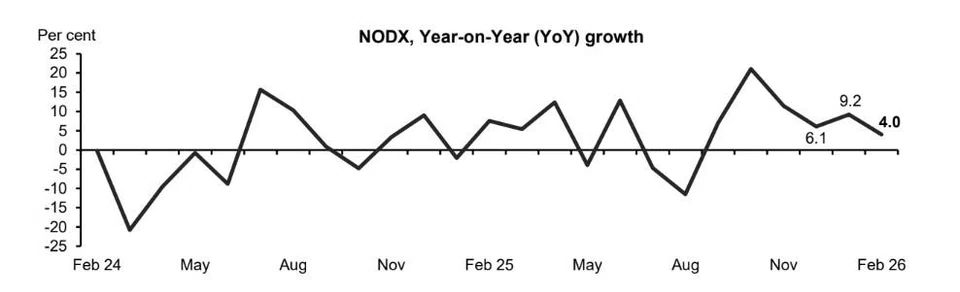
Non-oil domestic exports (NODX) expanded 4 per cent, after a revised 9.2 per cent growth in January, according to figures released by Enterprise Singapore on March 17. The growth was less than the 5.3 per cent forecast by analysts in a Bloomberg poll.
NODX grew 6.7 per cent in aggregate over January and February – smoothing out the impact from the shifting Chinese New Year holidays.
Electronics exports jumped 43.2 per cent in February from a year earlier. Disk media products expanded the most, at 96.3 per cent, while integrated circuit exports rose 51.2 per cent, and PC exports rose 22.9 per cent.
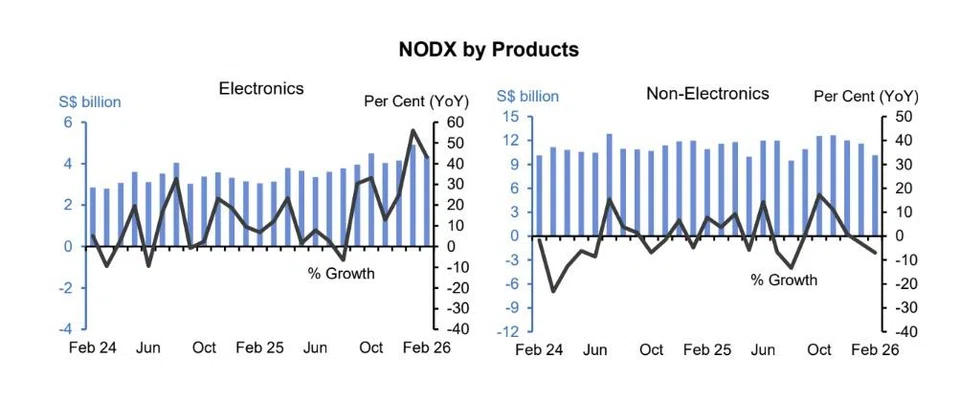
Non-electronics NODX dropped 6.9 per cent year on year, after a 3.1 per cent decline in January. The declines were seen across food preparations, petrochemicals, and non-monetary gold.
In terms of markets, exports to South Korea, Taiwan and Hong Kong rose the most compared with a year ago, while exports to the United States and Indonesia contracted.
Non-electronics exports to the US slumped 59.2 per cent from a year ago, while electronics exports to the country climbed by almost 95 per cent.
There is more uncertainty ahead. The US on March 11 launched a trade probe on Singapore and 15 other trading partners for excess manufacturing, which could allow the Trump administration to impose tariffs as high as 100 per cent or more on specific goods.
It announced a second probe on March 12 into 60 economies – including Singapore – over failures to take action on forced labour and whether these burden or restrict US trade.
The war with Iran, which was launched by the US and Israel on Feb 28, has also effectively closed a waterway that typically handles a fifth of the world’s oil supplies, with no end to the conflict in sight.