
From prayer to care: Pilot scheme turns places of worship into ‘third spaces’ for seniors
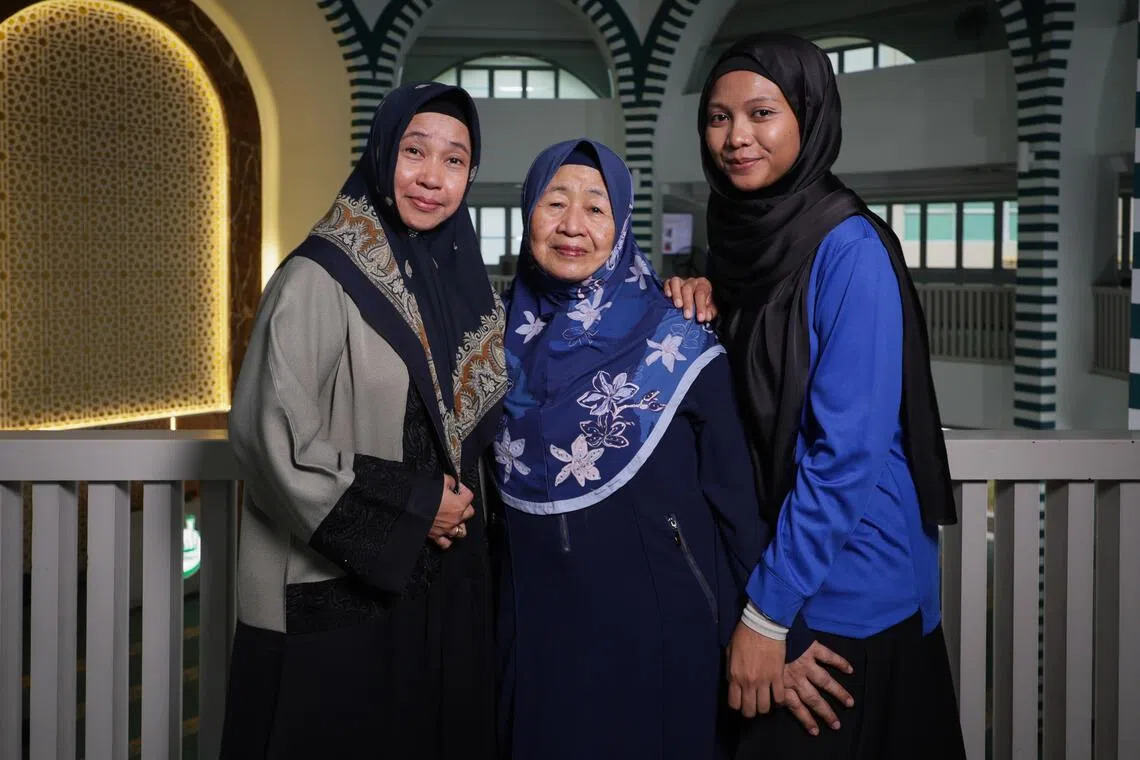
(From left) Retirees Hamidah Wan, 57, and Ramlah Rasul, 71, with Allkin’s senior social worker Suriani Umar at Masjid Al-Muttaqin on Aug 26. (ST PHOTO: GIN TAY)
For five years, Ramlah Rasul has been the primary caregiver to her 78-year-old husband, who has multiple health problems, including gout and arthritis.
It has taken a toll on her own health and well-being. The 71-year-old retired administrative executive who underwent knee replacement surgery in 2025 finds it increasingly difficult to push her husband’s wheelchair as she manages her own diabetes, hypertension and thyroid problems.
Emotionally exhausted, she tried to seek support at an active ageing centre near her home, but found it difficult to connect with others there as she had no “kaki” (close friend).
On one of her weekly visits to Masjid Al-Muttaqin in April, she approached a social worker from Allkin Singapore.
Allkin’s Suriani Umar referred Ramlah for counselling services at Club Heal, and also connected her with someone from the mosque to explore MUIS’ financial assistance schemes.
Said Ramlah: “I pour out my problems, and I get a listening ear. I still face challenges, but I know I’m not alone now.”
The tie-up between Allkin and Masjid Al-Muttaqin in Ang Mo Kio is part of a broader effort involving the Lien Foundation, the Islamic Religious Council of Singapore (MUIS) and Masjid Al-Islah in Punggol to build a model that can bridge Muslim seniors and the wider community care network.
The initiative aims to tap places of worship as third spaces where spiritual care can be a gateway to the larger system of integrated social and health support.
This programme is an extension of an existing Santunan Emas initiative which started at Masjid Al-Muttaqin in 2024. It supports Muslim seniors and their caregivers through spiritual guidance and community care.
Mosques and religious figures can be important and trusted sources of support for Malay/Muslim seniors, who may not always approach formal services first, said Ong Pei Ni, director for care and integration at Allkin Singapore.
Malay/Muslim seniors make up about 8 per cent of attendees across its 10 active ageing centres, said Ong.
Al-Muttaqin’s senior mosque executive chairman Mohd Fairus Abd Manaf said the mosque can play a broader role by working together with community and healthcare partners to provide more holistic support for seniors and caregivers.
“While spiritual guidance remains an important aspect of their lives, many seniors and caregivers also need support in areas such as health, social connection, active ageing and navigating different stages of life,” he said.
Under the programme, Allkin established a “social worker clinic” at Masjid Al-Muttaqin where congregants can seek help from the social workers on a variety of social and healthcare issues.
The 12-month pilot from February 2026 to January 2027 is the foundation for a model to be replicated across the broader mosque ecosystem in Singapore. It will be expanded to Masjid Al-Islah in Punggol in September.
As at Aug 19, the clinic in Ang Mo Kio has recorded 71 cases, with the top three concerns being future care planning, caregiver support and financial concerns.
Allkin also plans to develop a faith-sensitive guide for practitioners and community partners who deliver support within faith-based settings.
Religious places as third spaces
Lien Foundation chief executive officer Lee Poh Wah said seniors tend to gravitate towards places that have held meaning through their lives, rather than walk into an unfamiliar active ageing centre.
“Our care systems are built on the assumption that seniors will come to us,” he said. “They are already gathered, in large numbers, in places of worship we have not thought to walk into. It’s time our care systems acknowledge and integrate this reality.”
Paulin Straughan, director of Singapore Management University’s Centre for Research on Successful Ageing, said places of worship bring together individuals who share common beliefs and values.
This can help lower barriers to social interaction, foster trust and create opportunities for meaningful relationships to develop. In turn, they can strengthen networks of mutual support and caregiving within the community, she said.
She noted that other places of worship, such as churches and temples, also serve as gathering places where devotees come together for worship, personal reflection and social interaction, and some welcome non-members to community celebrations.
“Sustained participation by non-believers may depend on whether social and community-oriented activities can be offered in ways that are welcoming and meaningful without requiring religious commitment,” she said.
Singapore University of Social Sciences associate professor Kelvin Tan said the model can be extended to other places of worship, as some are already running non-religious activities like kindergartens and enrichment classes.
“In a highly urbanised Singapore where space is limited, religious organisations could think about how to make better use of their premises,” he said. “When these spaces are not being used for religious purposes, they could be opened up for other community activities, creating ‘third spaces’ where people can meet, socialise and support one another.”
Retiree Hamidah Wan, 57, who lost her husband to cancer six months ago, turned to the mosque and Allkin for help in July.
She was connected with an ustaz who provided spiritual guidance as she coped with her grief. Allkin also explored active ageing centre activities and volunteering opportunities with her to keep her occupied.
“The mosque is a safe place,” she said. “It’s OK to just walk in and seek help.”