Finding Their Artistic Voice: Inside IB Visual Arts at NLCS (Singapore)
What is the difference between learning art and learning to become an artist?
For students studying IB Visual Arts at North London Collegiate School (Singapore), the transition happens gradually. Technical skills are built over the years, alongside an understanding of art history, critical thinking, and the ability to engage with ideas. By Diploma level, however, something begins to shift.
Students increasingly take ownership of what they want to explore, the materials they choose, and the direction their work takes.
As Alex Sanson, Head of Senior Art at NLCS (Singapore), puts it, this is the point at which students begin moving from being “an art student to an artist.”
For IBDP student Gu Han Yun, that journey has meant learning to trust her instincts, embrace uncertainty, and develop a visual language of her own.
Building the Foundations
Independence in the Diploma years does not begin from a blank canvas.
Throughout Middle and Senior School, students encounter a broad range of art-making techniques, including clay sculpture, sculpture using found materials, graphics, painting, drawing and printmaking. The aim is to give students a strong technical foundation from which they can later make their own creative decisions.
But technical skill is only part of the picture.
At NLCS (Singapore), Visual Arts is approached within an academic framework. Art history provides context, written work is an important part of students' development, and students are encouraged to draw on their knowledge of the wider world when creating.
For Sanson, art is as much an intellectual process as a creative one. Critical thinking, knowledge and context enable students to move beyond simply making something visually interesting and begin considering what their work might communicate.
That can mean drawing connections with ideas encountered in history, geography, economics, mathematics, or elsewhere in their education. Creativity, in this sense, becomes a way of taking existing knowledge, materials, and ideas and combining them in new ways.
By the time students reach the Diploma Programme, they have a growing toolkit from which to decide how best to communicate ideas of their own.
From Idea to Enquiry
For Han Yun, the question guiding her current practice is:
“How can the interplay of stillness and flow in visual art reflect the fluid nature of existence?”
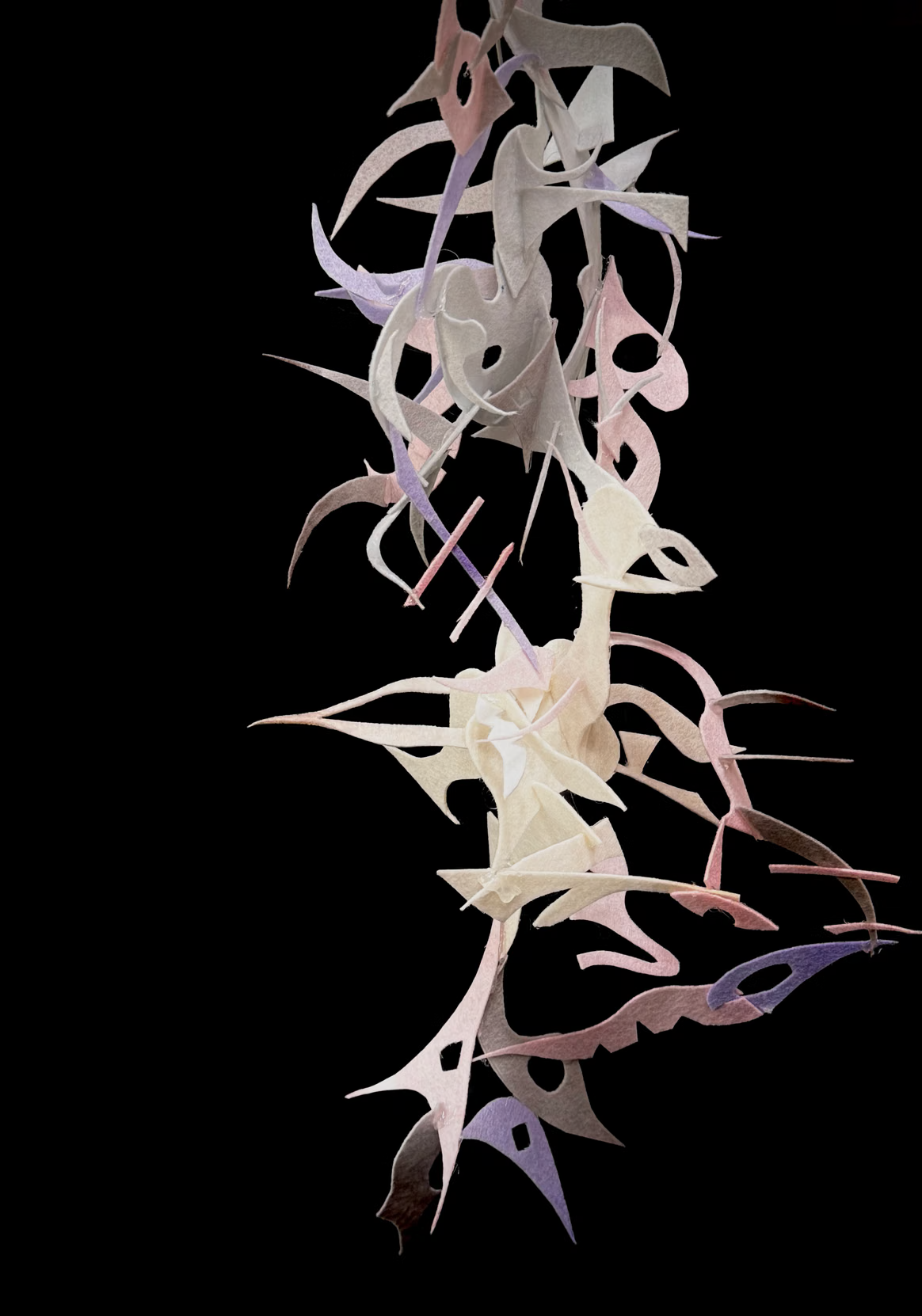
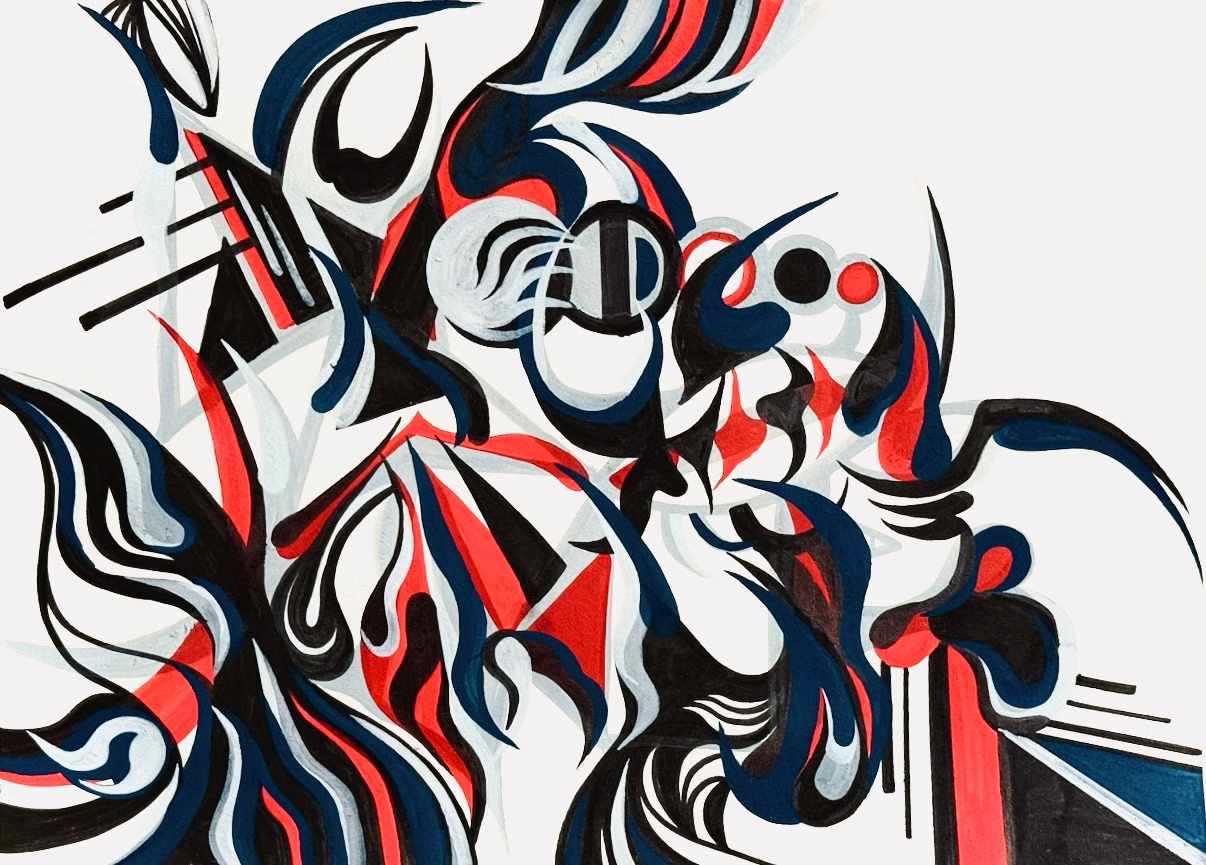
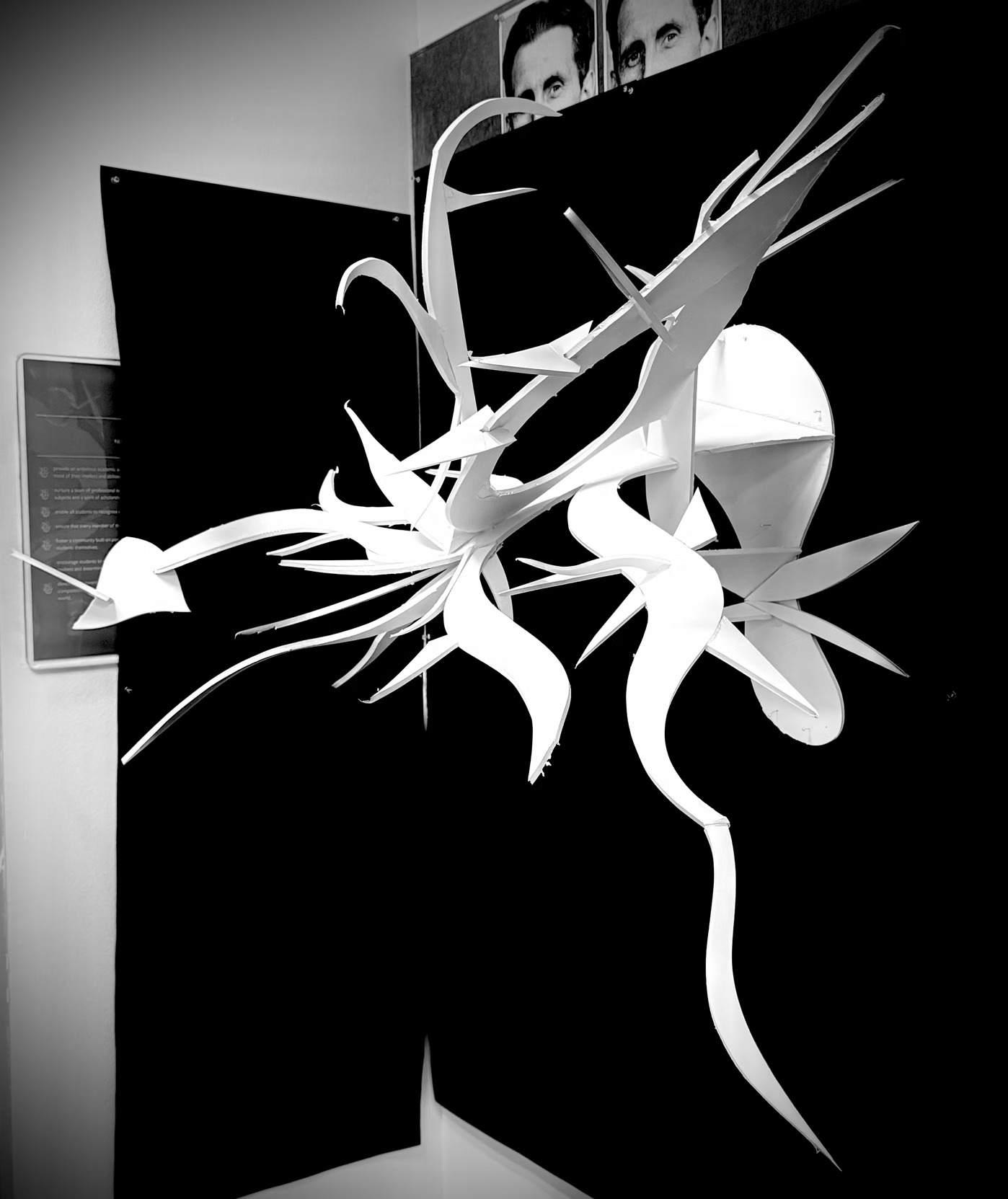
Rather than answering that question through a single medium or predetermined outcome, she has allowed it to develop across a body of work spanning painting, paper sculpture, photographed sculpture and suspended three-dimensional forms.
In Red, Blue, Black, contrasting colours, curved lines and fragmented forms create a sense of continuous movement, while areas of empty space introduce moments of stillness. In another work, Han Yun cuts, bends and layers paper into abstract forms inspired by the organic lines and textures found in nature, using the contrast between sharp and curved shapes to explore the tension between flow and resistance.
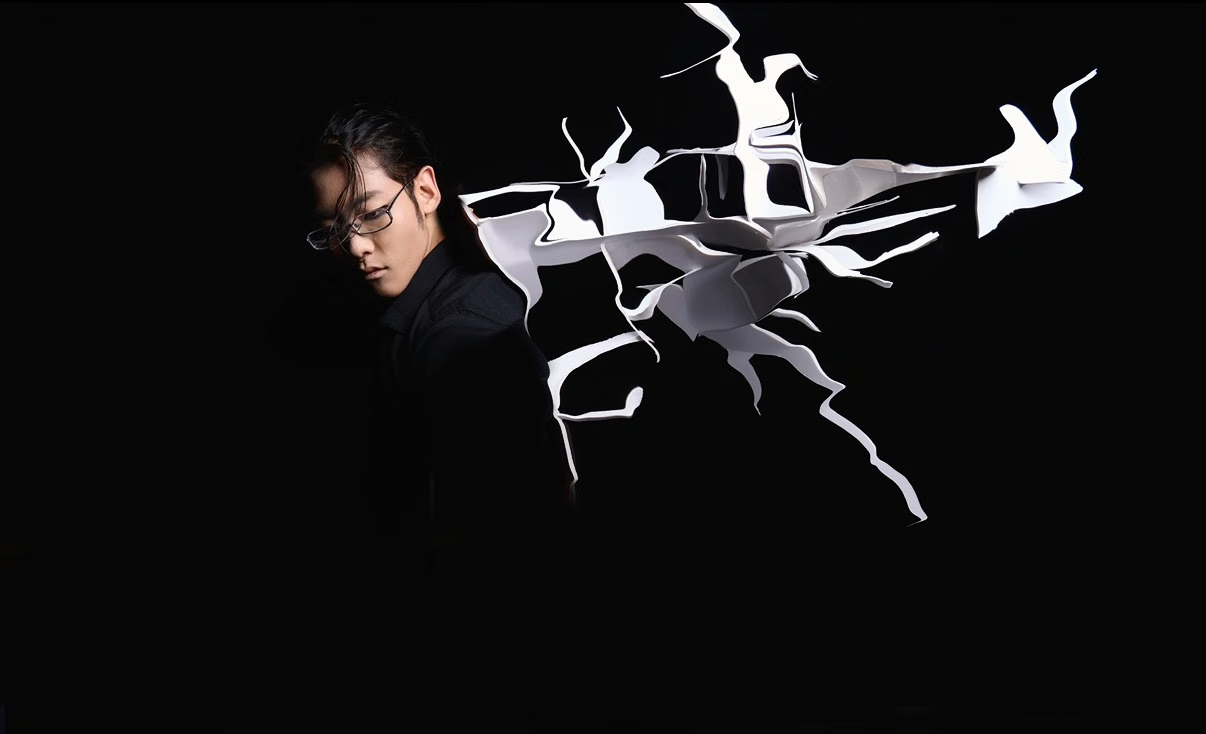
Her enquiry develops again through photography. After creating an abstract paper sculpture, Han Yun worked with a model and later developed the image digitally, investigating how an object that is physically static can suggest movement and transformation when placed in dialogue with the human body.
Across the works, the medium changes, but the question continues.
Making First, Understanding Later
Perhaps more important than the final pieces is the process behind them.
Han Yun describes her creative approach as intuitive. Too much planning at the beginning, she has found, can restrict her creativity. Instead, she prefers to start the creation process, experiment with materials, and allow an idea to reveal itself through the process.
“Often, I understand what I am trying to express after making the work rather than having a completely fixed meaning beforehand,” she explains.
That willingness to work without knowing exactly where an idea will end up is an important part of developing independence as an artist.
It is also something Sanson has encouraged.
Han Yun recalls sometimes questioning whether an abstract work needed a clearer meaning. Rather than encouraging her to impose one from the outset, Sanson encouraged her to “make first and reflect afterwards.”
The advice has changed how she approaches her practice.
His encouragement to “go with the flow,” she says, has helped her trust her own instincts and responses to materials, allowing the artwork to evolve more naturally.
Learning to Think Like an Artist
That balance between freedom and intellectual rigour sits at the heart of the Visual Arts approach at NLCS (Singapore).
Students are not simply given complete freedom and expected to know what to do with it. The years leading to Diploma Art build the technical knowledge, contextual understanding and critical thinking needed to make that freedom meaningful.
At Diploma level, students can then begin applying those foundations with increasing independence: developing their own ideas, deciding which art processes will communicate the idea most effectively and taking responsibility for the direction of their work.
For Sanson, this is what makes the Diploma years particularly exciting. Students begin controlling their own projects and generating their own ideas, while the teacher increasingly supports rather than determines the direction of the work.
The result is not a classroom in which every student arrives at the same answer.
It is one in which students learn how to ask better questions.
Finding a Visual Language of Their Own
Han Yun's five works remain connected by the same enquiry, but each work approaches it differently.
Through line, negative space, fragmentation, suspension and organic forms, she explores how stillness and movement can coexist. Rather than directly representing nature, she translates qualities of natural movement into abstract forms, asking how something physically static might still communicate transformation and the fluidity of existence.
In doing so, she is also learning something beyond any individual painting or sculpture: how to recognise and trust her own creative instincts.
That is ultimately what the progression towards IB Visual Arts at NLCS (Singapore) is designed to support. Technical ability matters. Knowledge matters. Research, writing, and context matter. But those foundations increasingly give students the confidence to make decisions for themselves.
The goal is not simply to teach students how to make art.
It is to give them the knowledge, skills and independence to begin understanding what they want to say, and how they want to say it.
About North London Collegiate School (Singapore)
Founded in August 2020, North London Collegiate School (Singapore) is a British international school offering the academically ambitious NLCS curriculum, followed by the International Baccalaureate (IB) Middle Years Programme from Grade 6 to Grade 10 and culminating in the IB Diploma Programme in the Sixth Form.
Drawing on more than 175 years of educational heritage from its founding school, North London Collegiate School, established in London in 1850, NLCS (Singapore) nurtures individuals to be intellectually curious, socially confident, and grounded in compassion through a rigorous academic framework, rich co-curricular opportunities, and exceptional pastoral care.
Situated on Depot Road, the School is part of a global family of schools committed to educational excellence and developing global citizens.
To learn more about NLCS (Singapore), please visit our website (https://nlcssingapore.sg/) and follow us on Instagram, Facebook, YouTube, and LinkedIn.
For media enquiries, please contact the NLCS (Singapore) Marketing Team
Email: marketing@nlcssingapore.sg