
Employers urged to look beyond degrees, job titles when hiring under new skills-first framework
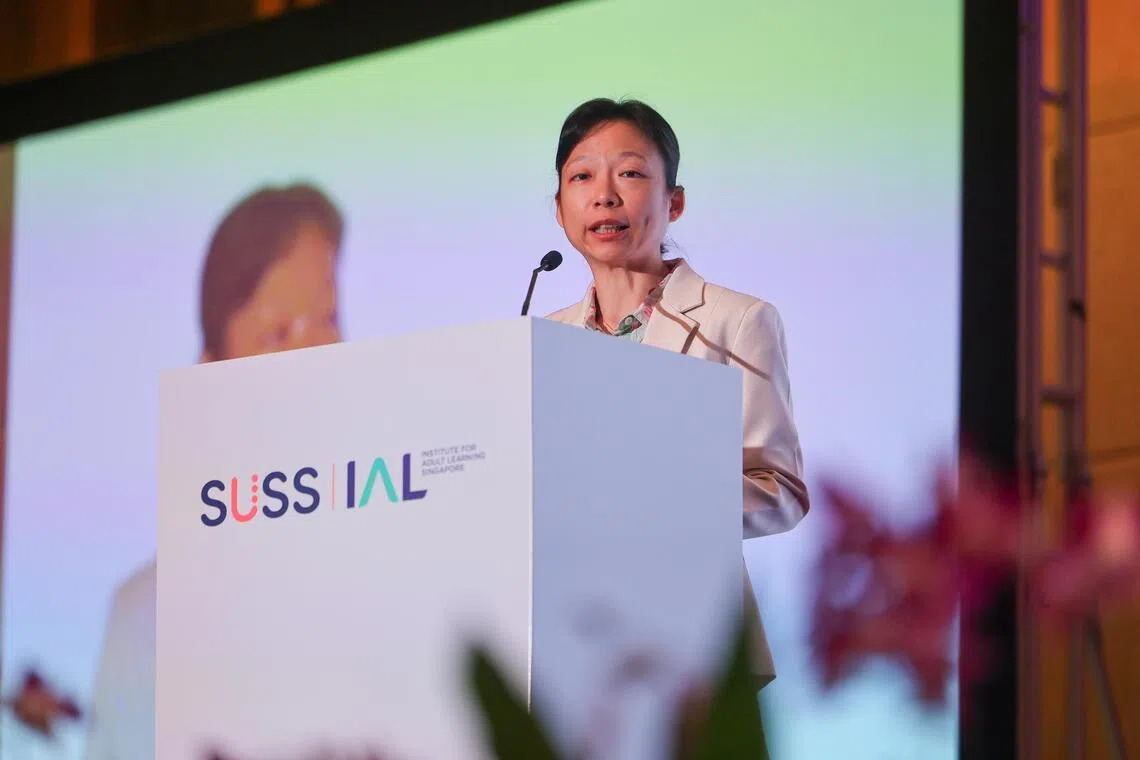
Acting Minister for Manpower Jasmin Lau said employers typically begin assessing applicants by asking about previous jobs and educational qualifications. (PHOTO: LIANHE ZAOBAO)
Source: The Straits Times
Employers are being urged to look beyond academic qualifications and past job titles when hiring and promoting workers under a new framework aimed at making skills a bigger consideration in workforce decisions.
The Skills-First Framework for Action, launched by the Institute for Adult Learning (IAL) on Oct 19, proposes 12 pilot initiatives to help companies identify, develop and better use workers’ skills, while creating more career opportunities for Singaporeans.
At the launch at the Sands Expo and Convention Centre, Acting Minister for Manpower Jasmin Lau said employers typically begin assessing applicants by asking about their previous jobs and educational qualifications.
But such information reveals “more about where someone has been, rather than where that someone can go”.
A “skills-first” approach would instead ask what workers can do and what they can learn to do next, said Lau, who is also Senior Minister of State for Digital Development and Information.
Such practices, while not new, matter more today with jobs being transformed, skills going out of date sooner and career switches becoming more common, a process sped up by artificial intelligence, she said.
The framework was co-authored by the Skills and Workforce Development Agency, National Trades Union Congress, Singapore Business Federation, Singapore National Employers Federation and Singapore University of Social Sciences after two years of research and conversations with industry players.
Its proposals include initiatives for employers to redesign jobs and hiring practices around needed skills and to encourage workers to regularly review their skills and career goals.
The ideas proposed will be trialled with relevant stakeholders, while IAL will develop an observatory to study the implementation and effectiveness of such “skills-first” practices.
The framework builds on Singapore’s SkillsFuture movement, which began 11 years ago. In 2025, the training participation rate for resident workers in the Republic reached a new high of 54.8%.
Individuals need to take ownership of their skills and careers, while employers should use, develop and recognise these skills, said Gog Soon Joo, senior director at IAL’s Centre for Skills-First Practices.
At civil works firm HSC Pipeline Engineering, assistant project manager Nelson Lai carved out a path to his desired engineering role despite lacking the typical academic qualifications, as his employer was willing to help him grow into the job.
The 33-year-old, who has a diploma in business management and began his career doing administrative work at another firm, now manages a team of on-site engineers.
This is a role typically handled by a trained engineer.
In an interview with The Straits Times, Lai said that in his job, he would consult more experienced colleagues and proved himself by finding a way to use a new utility-mapping technology to boost efficiency.
“That’s where I asked (my boss), can I get this certification? Can I upskill myself?” he recalled.
His employer agreed to send him for training, and Lai eventually completed more than a dozen courses over three to four years. This enabled him to move into more technical roles.
HSC managing director Shane Shi said his firm has had to look beyond candidates from traditional backgrounds as hiring in the construction industry grows more difficult.
“Skills can be learnt,” he said, adding that what mattered most to him was a candidate’s attitude and willingness to try new things.
At mechanical and electrical contractor DLM, managing director Joseph Goh has also broadened hiring to include non-degree holders who have acquired the requisite skills through work experience or whom the company later sends for additional training.
To Goh, educational background matters less as workers progress further in their careers. A candidate who can “do a heat load calculation using the E20” method, for example, is more attractive than someone who has a degree in mechanical engineering but cannot do so.
He said: “The skills they have acquired (are) more important than the actual degree that they hold.”