
AI adoption among businesses in Singapore rises; digital economy accounts for larger share of GDP
Latest figures from the Singapore Digital Economy Report released by IMDA on Oct 5 showed that adoption of AI among enterprises rose from 14.7% in 2024 to 23.5% in 2025. (ST PHOTO: KELVIN CHNG)
Source: The Straits Times
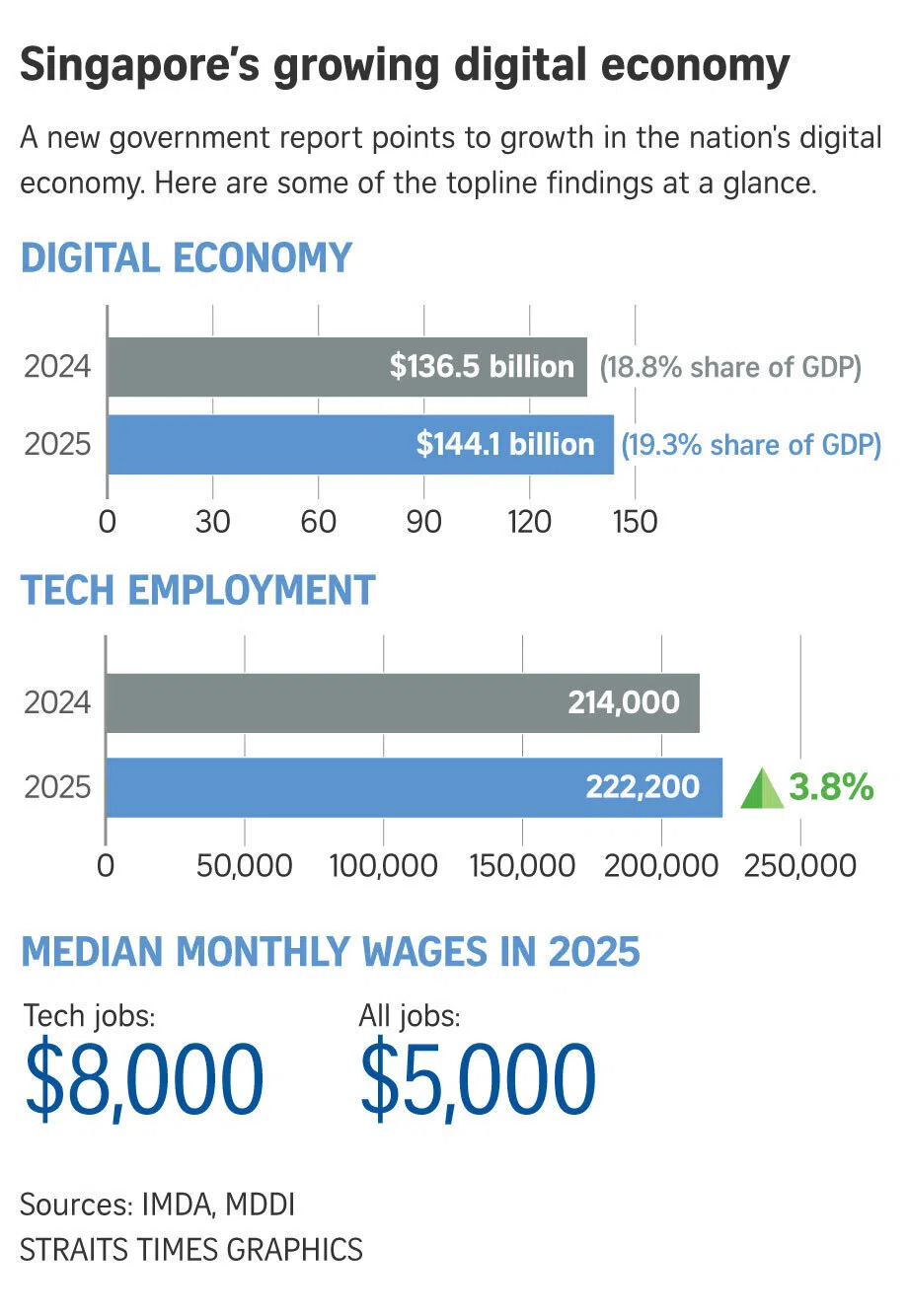
Adoption of artificial intelligence among all enterprises in Singapore has risen, with over one in five businesses here using the technology in 2025, while the country’s digital economy grew to over $144 billion and accounted for a larger share of the nation’s gross domestic product.
Correspondingly, tech employment grew 3.8% year on year to 222,200 in 2025, from 214,000 in 2024, with the fastest-growing roles in AI, data and cybersecurity, according to the latest figures from the Singapore Digital Economy Report.
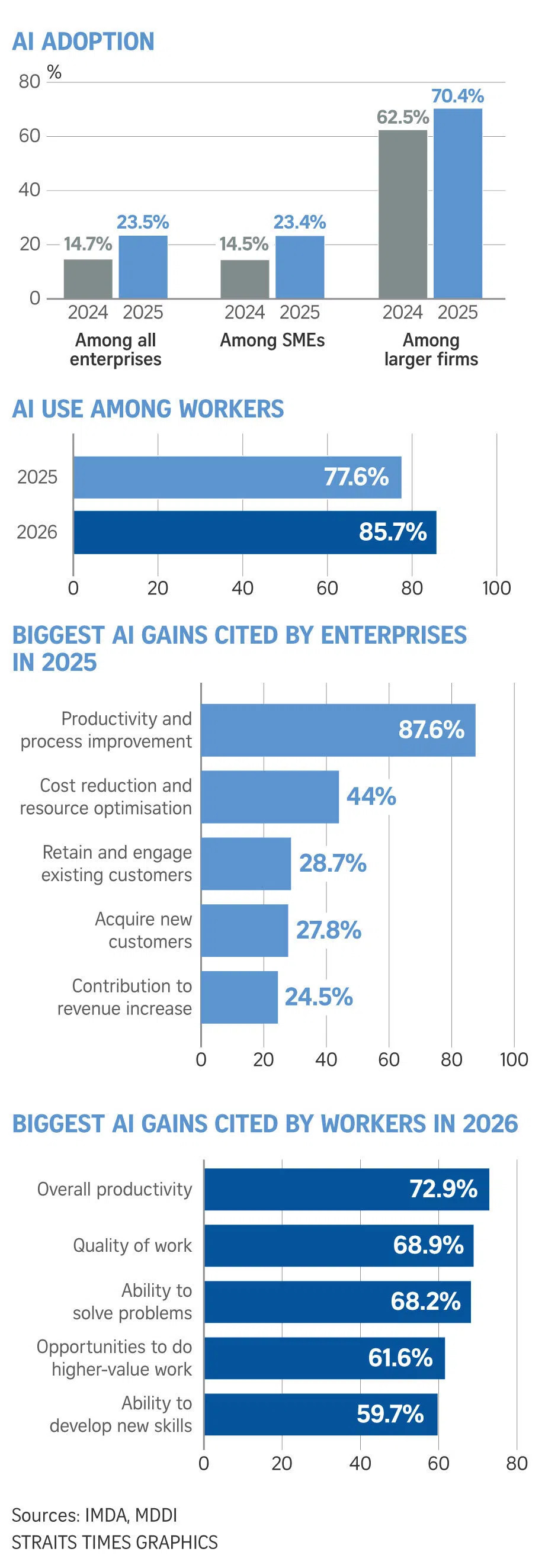
Released by the Infocomm Media Development Authority (IMDA) on Oct 5, the report showed that adoption of AI among all enterprises rose from 14.7% in 2024 to 23.5% in 2025.
Specifically, AI adoption among small- and medium-sized enterprises (SMEs) rose from 14.5% to 23.4%, while adoption among larger businesses jumped from 62.5% to 70.4% over the same period.
Singapore’s digital economy grew from $136.5 billion in 2024 to $144.1 billion in 2025, with its contribution to the nation’s GDP rising from 18.8% to 19.3% year on year.
IMDA said that the steady growth of the digital economy “reflects that digital technologies continue to shape how all enterprises across various industries operate, and how workers do their jobs”.
The report calculates the digital economy based on two components.
The first is the value-add or economic contribution of the information and communications sector, which comprises digital services typically associated with the tech industry like telecommunications, computing and software.
The second is the value-add that non-tech industries have derived from embracing digital technologies and solutions.
Non-tech industries accounted for the biggest share of Singapore’s digital economy, growing 3.6% to $97 billion in 2025 from a year ago. The tech sector expanded 6.1% to $47.1 billion over the same period.
IMDA said that demand for tech talent is concentrated outside the tech industry. Growth in tech employment was led by non-tech sectors at 5.3% compared with 1.8% in the tech sector.
Wages for tech jobs also continue to be high. In 2025, tech workers’ median monthly salary was $8,000, 60% higher than the overall median for all resident workers at $5,000. In 2024, median wages for tech workers and all workers was $7,950 and $4,860 respectively.
Digitalisation remains high too, with 96.4% of all businesses having adopted at least one out of six digital areas in 2025, up from 95.1% in 2024. The six digital areas are cybersecurity, cloud technologies, e-payments, e-commerce, data analytics and AI.
More businesses are planning to use AI. The proportion of enterprises that have not adopted AI but plan to do so in the next 12 months doubled from 5.6% in 2023 to 12.1% in 2025.
For companies already using AI, two in five are also moving from experimenting with the tech to implementing it more broadly across their operations.
Businesses that are using AI are also reporting tangible outcomes, with IMDA noting that firms are “primarily realising AI benefits through efficiency gains and better use of resources”.
The biggest benefit cited by enterprises was improvements in productivity and processes, with nearly 88% saying so. This was followed by 44% citing lower costs and optimisation of resources.
AI gains among workers
Workers are reporting gains from AI as well. IMDA said that AI use is accelerating among workers, with nearly 86% of them using AI at work in 2026, up from 78% the year before.
Improvements in productivity was the top benefit AI users cited, with nearly 73% saying so. The next biggest benefits were better work quality (69% of users cited this) and better problem-solving abilities (68% of users).
Around a third of AI users said that they spent less time on tasks, with six in 10 saying they saved up to an hour a day, which could translate to more time to work on other things.
At work, employees mostly used AI for creating content, with almost 77% of them doing so. This includes generating and editing written content and visual content, such as images and videos.
The next most cited uses of AI at work were automating processes (64% of users did so) and engaging with people (54%). About 52% of users said they used AI for exploring data and data analytics at work.
But IMDA noted that despite strong AI use at work, there is still a gap. While 68% of workers realise they need to upskill or reskill in AI, only 37% of them have gone for training related to AI in the past 12 months.
Common reasons cited by workers for not attending training include not being nominated by their employers for it, with 35% reporting this. A similar proportion of workers said they did not have time, while about one in four were not sure which was the right AI course to take.
“This suggests that clearer signposting and broader support for workers to take up suitable training could help more workers build relevant AI capabilities,” said IMDA.
To this end, the agency is expanding its National AI Impact Programme to strengthen AI capabilities among tech and non-tech workers.
For tech workers, the programme will upskill 40,000 tech professionals over the next three years. They will be equipped with advanced AI skills to become developers that can engage in all aspects of software development, with know-how in the area of agentic AI, which are bots that can carry out actions with minimal human supervision.
For the non-tech workers, the AI programme will train 100,000 professionals by 2029 in AI skills relevant to specific domains. This is already being rolled out in sectors such as accountancy and law.
Association of Small and Medium Enterprises president Ang Yuit said that the use of AI is still very uneven among SMEs. Many of them face difficulties in finding time, the budget and manpower to plan how work processes can be automated by AI, said Ang.
“There are not as many specialised talents with strengths and experience in implementing AI for enterprises, compared to more established work functions like social media marketing,” he added.
OCBC chief economist Selena Ling said that Singapore’s digital economy growth may not benefit workers equally.
“It depends on whether workers are in growing industries with core digital domains that have a talent shortage, or if workers are in industries that are lagging behind and which may stagnate without government intervention due to structural skills mismatch or job displacements arising from AI and tech automation,” she said.