
Across land, sea and air, fuel price hikes drive up costs for passengers and operators in S’pore
(Photo credit: ST Photo/Mark Cheong)
Source: The Straits Times
For private-hire car driver Muhammad Fauzi, rising petrol prices – the highest since 2022 – caused by the war in Iran have dented his take-home earnings.
The 44-year-old said he earned about $1,400 to $1,600 in the past week, instead of his usual $1,700 to $1,900, despite clocking more than 12 hours on the road daily.
While ride-hailing platform Grab has offered him a $40 fuel voucher to defray the higher costs, Mr Fauzi said the one-off voucher is not sufficient as fuel prices are still on the rise. “The voucher can’t even pump one full tank. (They) might as well don’t give,” he said.
Across land, air and sea transport, consumers are feeling the pinch from the surge in fuel prices caused by the Iran conflict, which is choking a waterway for oil supplies.
Land transport: Coping with rising pump prices
Some private-hire car drivers, such as Mr Teo Chee Chye, have found ways to circumvent the high fuel costs.
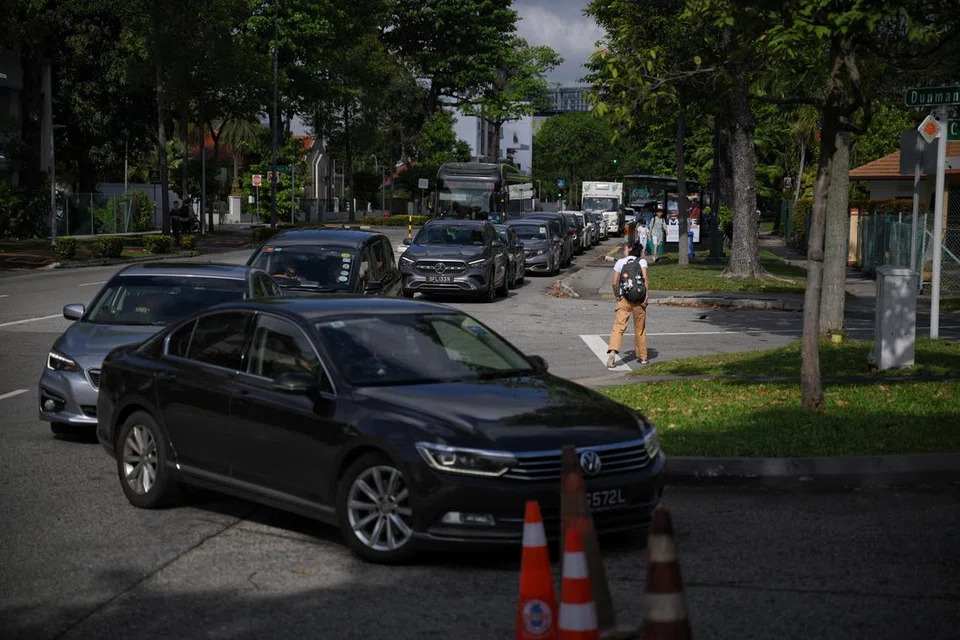
The 52-year-old ride-hailing driver of eight years joined a long queue of vehicles to refuel his car at a Cnergy petrol station in Dunman Road after finding out about its lower fuel prices on social media.
Describing the recent hike in oil prices as “very crazy”, Mr Teo observed that spending $50 filling up his car now gets him only 13 litres of 95-octane petrol at petrol stations that charge more, much lower than the 17 to 18 litres he used to get before the conflict broke out.
As at 10am on March 17, prices at Cnergy were at $2.35 a litre for 95-octane petrol and $2.65 a litre for 98-octane petrol.
Elsewhere, 95-octane petrol costs $3.47 a litre at Caltex, Shell and Esso before discounts are applied, and $3.39 at SPC.
The same grade of petrol used to cost $2.88 a litre at most petrol stations on Feb 28, when the conflict broke out.
When The Straits Times visited the Cnergy petrol station between 9am and 10.15am on March 17, there was a continuous line of more than 20 vehicles queueing to pump petrol, with around half of them displaying private-hire vehicle decals. Each vehicle had to wait around 15 to 20 minutes for its turn.
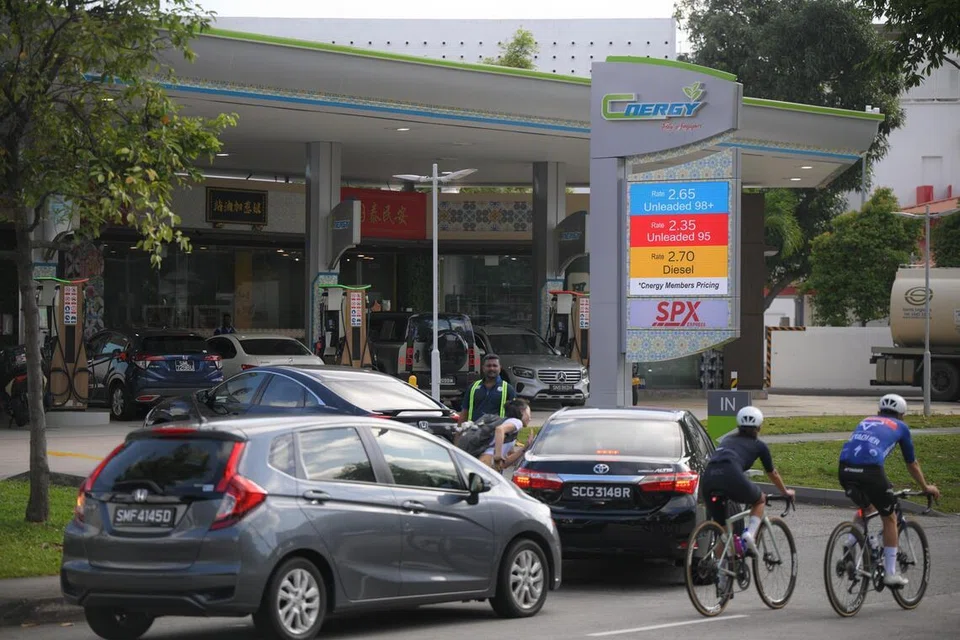
Also in the queue was contractor Ken Wong, 58, who has been a frequent patron of Cnergy due to its lower fuel costs – even before oil prices shot up after the conflict.
He added that filling up one full tank of petrol at Cnergy can cost $20 to $30 less than at other petrol chains.
On March 15, Consumers Association of Singapore president Melvin Yong called on petrol companies to exercise greater transparency and restraint in price adjustments.
On March 17, Singapore’s largest taxi operator ComfortDelGro said it will temporarily raise its metered fares and introduce a fee on app bookings to help drivers manage higher operating costs from March 24 to May 31.
ComfortDelGro said it is also providing fuel subsidies at its in-house fuel pumps and giving fuel credits to its drivers for four weeks, with potential for an extension.
Ms Khoo Gui Ju, general manager of taxi operator Strides Premier’s vehicle leasing business, said it will offer its drivers fuel prices at its in-house fuel kiosks that are up to 35 per cent lower than those at most fuel stations on the market.
To help private-hire car drivers navigate fuel hikes, ride-hailing platforms told ST that they have put various measures in place.
Grab said it will continue to provide fuel discounts to drivers and extend additional fuel vouchers to its most active drivers. It did not elaborate on how long the platform will provide drivers with such support.
Gojek said it will provide fuel discounts of up to 37 per cent at participating Esso stations and a one-time fuel subsidy to eligible drivers, as well as additional fuel vouchers for drivers in the higher tiers of its driver reward scheme.
Tada said it will press ahead with its initiative to help drivers secure more back-to-back trips during peak-demand periods on weekdays to improve their trip frequency and earnings.
Ryde said it will continue its zero per cent commission model to allow its drivers to retain full fare earnings.
The four ride-hailing platforms did not comment on whether rising fuel prices would eventually result in higher fares.
Operators of cross-border bus services have also found themselves facing challenges because of higher fuel costs.
Mr Kevin Tay, business manager of CityLine Travel, said operating costs have increased by around 30 per cent, mostly due to higher fuel expenses.
He added that the company is exploring the optimisation of bus schedules based on demand, improving the efficiency of routes and managing fleet deployment more carefully during off-peak periods.
In some cases, it is working with customers to adjust their departure times by one or two hours so that more passengers can travel on the same bus, Mr Tay said.
He noted that the company has no plans to increase ticket prices for now, given that the cross-border bus market remains highly competitive.
Aviation: Higher fares loom; SIA, Scoot don’t impose fuel surcharge
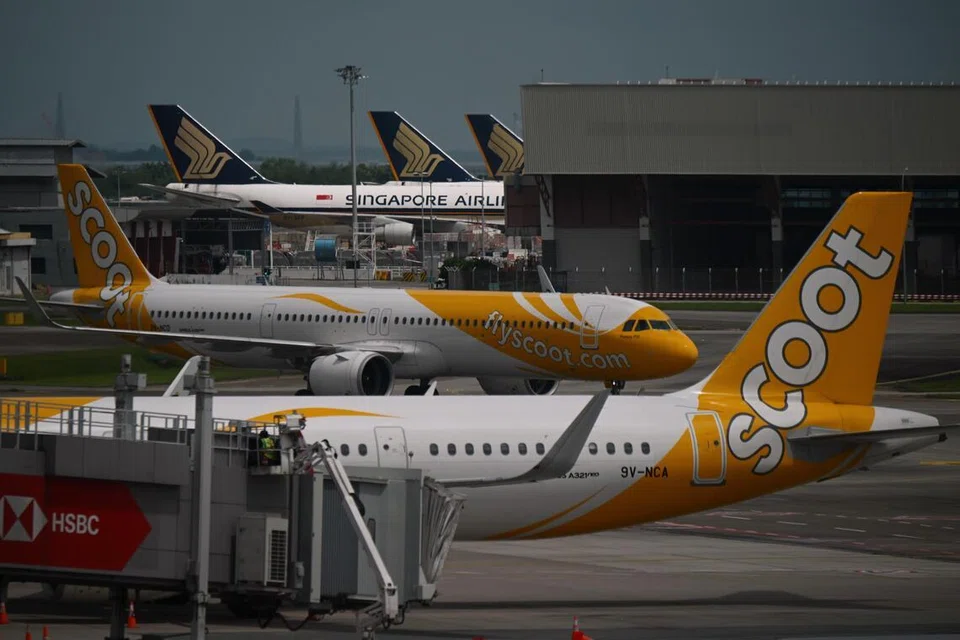
Airline passengers may face the prospect of paying more to fly down the line, with some airlines such as Hong Kong carrier Cathay Pacific and Thai Airways International already raising fuel surcharges and ticket prices.
Singapore Airlines (SIA) and its budget subsidiary Scoot said they do not currently impose a fuel surcharge on their flights.
An SIA spokeswoman said both airlines’ fares are determined by supply and demand and are, therefore, dynamic, reflecting prevailing market conditions.
She added that the SIA Group manages fuel-price risk through a disciplined fuel hedging programme, which reduces price volatility over time, while maintaining flexibility to respond to changes in the operating environment.
According to ST’s checks, fares for an economy-class seat on some flights from Singapore to London, Frankfurt, Paris and New York via carriers such as China Eastern Airlines, Korean Air and SIA rose by up to $670 between March 12 and 16.
By March 16, there were no available seats on some SIA flights bound for London, Frankfurt and New York on March 31.
There are also no remaining available seats for booking on SIA’s additional services to London and Frankfurt, which it announced on March 13 in response to higher air travel demand. This came amid major disruptions at aviation hubs in the Middle East, a traditional gateway between Asia and Europe, due to the war.
Economy fares for one-way flights operated by Lufthansa from Singapore to Munich, Germany, from March 19 to 31 were in the range of $2,444.30 to $7,806.80. Four of these flights are extra services mounted by the German carrier at short notice.
Mr Mayur Patel, head of Asia at aviation data consultancy OAG Aviation, said it is common to see fares going up when only a small number of flights can be deployed on certain routes, given that the ongoing Middle East geopolitical tensions have resulted in airspace restrictions and longer flight routes.
This is why airlines are prioritising the redeployment of aircraft to profitable routes and optimising the distribution of their network across routes with higher demand or strategic connectivity. This allows them to partially offset the displaced capacity from the Middle East, he added.
Sea transport: Fuel surcharges needed to offset rising costs
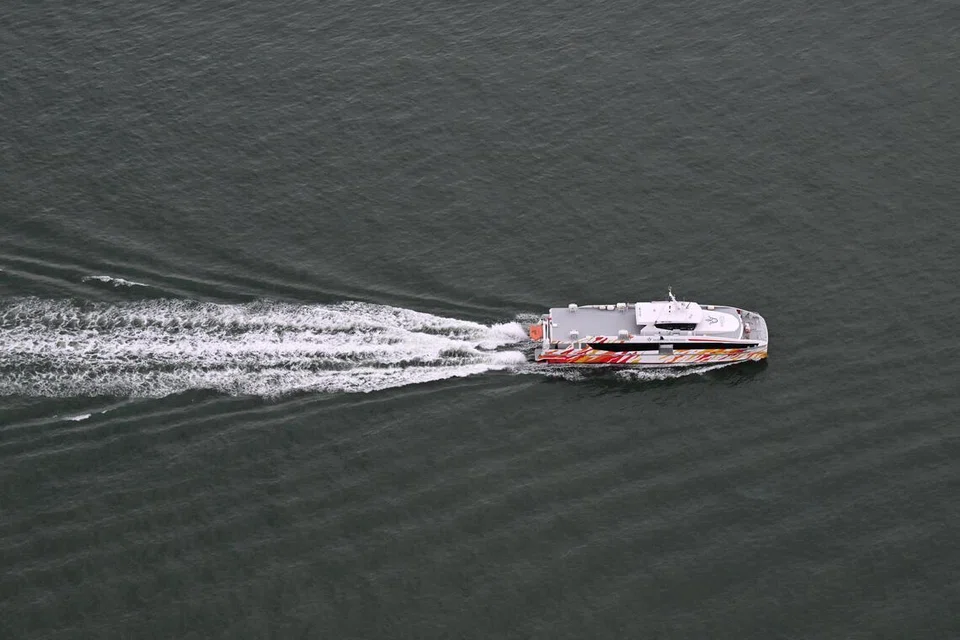
Those travelling by sea are also paying more for their journeys.
Homemaker Suzanne Marthioso will be halving the frequency of her trips between Singapore and Batam in Indonesia, from once a fortnight to once a month – owing to the higher cost of travel.
After ferry operators started rolling out fuel surcharges, the 53-year-old said the current cost of a return trip on the ferry – $86.90 – is too high.
This is more than what she would earn from one night of renting out her vacation rental home in Batam.
Noting that there is no option but to take the ferry to get to Batam, Ms Marthioso said she would cut down on the trips she makes to the Indonesian city for leisure, and head down only when she has to check on her vacation rental home.
Several ferry operators announced that they will impose a fuel surcharge of $6 for one-way trips departing Singapore from March 12. The surcharge is about $11 for a two-way trip between Singapore and Batam, or $12 for a return trip between Singapore and Bintan in Indonesia.
Mr Chua Choon Leng, general manager of BatamFast Ferry, told ST that this move is a response to the hike in fuel prices, which have “almost tripled” over the past few weeks.
He added that the fuel surcharge will help recover a “certain portion” of fuel costs for daily operations and will continue as long as oil prices stay high.
Echoing this, Horizon Ferry said in a circular on its website that the surcharge is “necessary” to offset rising operational costs, while ensuring the continued delivery of safe, reliable and efficient services.
It added that it will continue to monitor the fuel price situation closely and adjust the surcharge accordingly.