
S’pore to offer $40 million push to market for promising green solutions lying dormant in labs
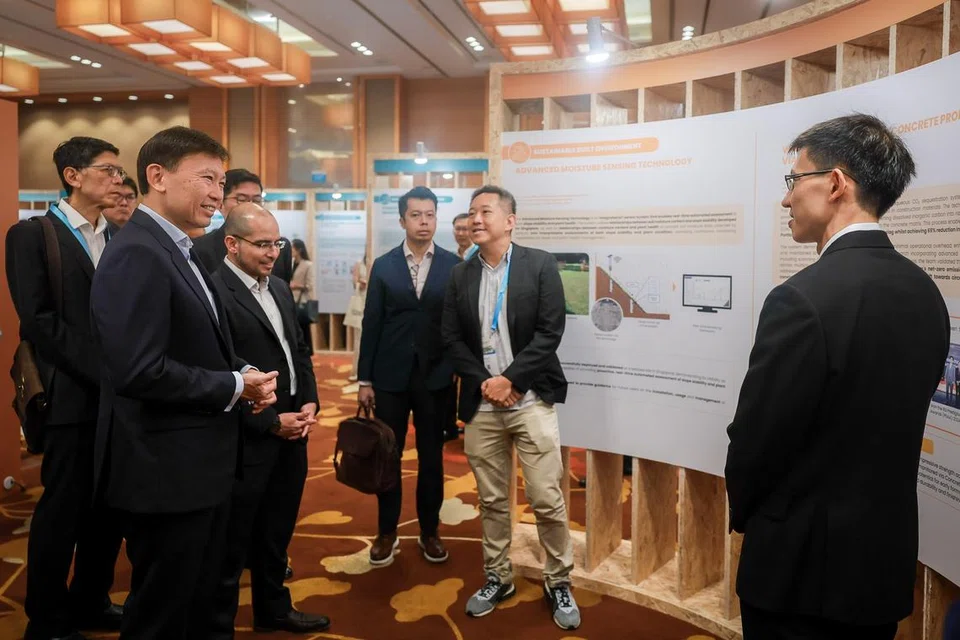
(Photo credit: ST Photo/Gavin Foo)
Source: The Straits Times
A $40 million fund has been launched to push promising climate and sustainability innovations out of the lab and into the marketplace.
The Urban Solutions and Sustainability Translation Fund aims to translate research in the areas of agri-food, waste, water and the urban environment, and unlock business opportunities.
“We need to address a persistent challenge we face in R&D – the gap between promising research and successful deployment... People refer to this as the ‘valley of death’,” said National Development Minister Chee Hong Tat, who announced the fund on Feb 5, alongside other research-related initiatives.
Many good research ideas struggle to find purchase in the real world because of technical, regulatory or commercial barriers, he added.
He was speaking at the Urban Solutions and Sustainability Research and Innovation Congress. The two-day conference is being held at the Sands Expo and Convention Centre on Feb 5 and 6.
“(The fund) will help to address critical barriers in technology translation, such as high upfront capital costs, and also address technological risks associated with early adoption,” he said.
Mr Chee highlighted a type of heat-reflective paint formulated by a Nanyang Technological University spin-off which can cool buildings by around 5 deg C – further than the 2 deg C reduction that commercial cool paint offers.
Beyond just reflecting heat, Entropy Lab’s paint can also reduce the surrounding environment’s humidity by absorbing moisture and evaporating it.
But Entropy Lab’s co-founder Koh See Wee says there is a hurdle in commercialising the paint, called PasteCool, as it is thicker than normal paint, which makes it harder to be certified locally based on existing standards.
Said Mr Chee: “We need to make sure that our rules can keep up to support these new innovations.
“In reviewing our rules and processes, we want to maintain high safety and quality standards, while keeping our frameworks clear, responsive, and enabling, so that promising ideas are not held back by funding gaps or outdated requirements.”
Eligible projects must address national priorities, originate from previous publicly funded research, have a working prototype and show a clear pathway to commercialisation, said the Ministry of National Development and the Ministry of Sustainability and the Environment, which are providing the fund.
Over five years, 20 research projects are expected to benefit from the fund.
They may include projects on water treatment technologies, and one that monitors the propagation as well as the occurrence of sinkholes during tunnelling works, said Mr Daniel Kuek, director of the Urban Solutions and Sustainability Innovation and Enterprise Office, which will manage the fund.
Urban solutions and sustainability is one of four pillars under Singapore’s multi-billion dollar research strategy, Research, Innovation and Enterprise (RIE) 2030. It focuses on reducing carbon emissions, strengthening the country’s ability to reduce climate change impacts such as extreme heat and rising seas, and ensuring Singapore remains liveable.
The new translation fund is an initiative under the $37 billion, five-year RIE 2030 plan, which was unveiled in December. Of the $37 billion, $10.8 billion has been earmarked for the four pillars, which also include manufacturing, trade and connectivity, human health and potential, and smart nation and digital economy.
The Straits Times has asked the National Research Foundation how much of the $10.8 billion has been allocated to the urban solutions and sustainability pillar.
Under the previous RIE 2025 cycle, the sustainability pillar saw several innovations that moved from laboratory research to deployment, including carbon-capturing concrete and innovative coastal defences.
Mr Chee also announced a $30 million Built Environment AI Centre of Excellence.
The new centre, to be housed in the Singapore University of Technology and Design, aims to develop solutions driven by artificial intelligence (AI) for challenges such as manpower shortage in the construction sector and energy-saving technologies.
The centre, set up in partnership with MND, will also tap RIE’s pool of funds.
Mr Chee said AI-powered software systems can orchestrate autonomous machinery for building sites, making operations smoother to reduce costly delays and protect construction workers.
“The power of AI can help us to process vast amounts of data, uncover new insights and automate complex tasks with greater speed and precision... (AI) must be paired with human judgment and also sector-specific expertise. I see it as a complement to our people to help us to do our job better,” he added.
AI is also a critical tool to ensure that MND’s key priorities, such as rejuvenating older estates, are met.
“Estate rejuvenation is a complex, long-term endeavour that can benefit from AI-enabled tech solutions across all stages of the (built environment), from urban planning to facilities management,” said MND and MSE in a joint statement.
Mr Chee noted that by 2040, more than half of Singapore’s public housing estates will be over 50 years old, which means that refreshing mature estates is critical for residents to continue having a quality living environment.
The Built Environment AI Centre of Excellence will also nurture professionals with both technical AI expertise and a practical understanding of challenges facing buildings and infrastructure.
On Feb 6, the Building and Construction Authority will launch a road map charting out nearly 70 different ways to decarbonise buildings.
Buildings account for more than 20 per cent of Singapore’s greenhouse gas emissions, from the air-conditioning and electricity used to embodied carbon – emissions arising from the manufacture, construction, transport and disposal of building materials.
Some of the solutions highlighted in the road map include carbon dioxide-absorbing paints and lowering air-con energy use by pairing fans with the air-cons, set higher at 24 deg C to 27 deg C.
And in addition to lining solar panels on rooftops, the document identified small-scale wind turbines as a potential form of renewable energy that buildings can harness.