
Singapore netted bigger haul of $14.2b in investments in 2025 despite challenging environment: EDB
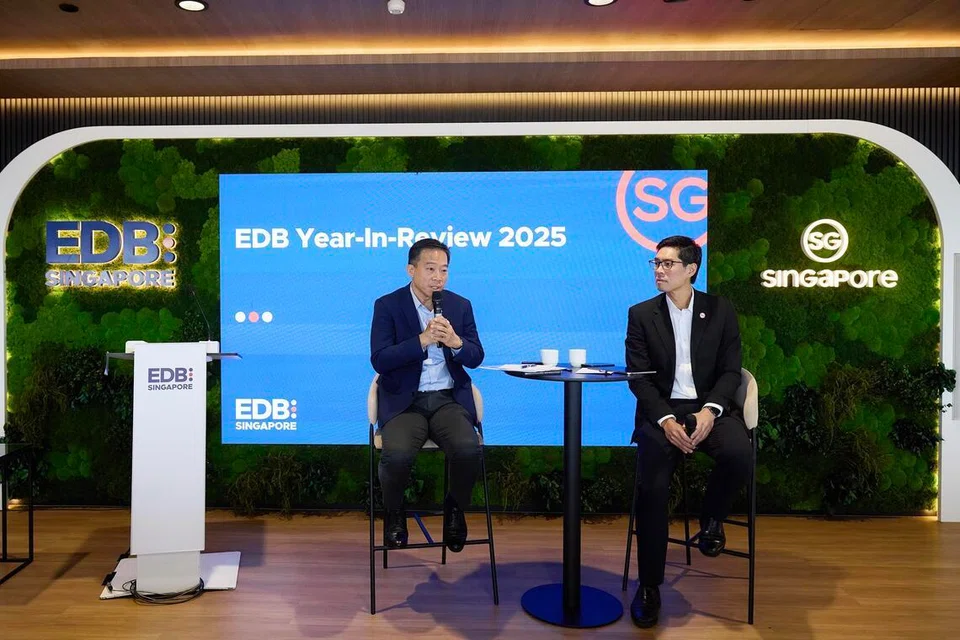
(PHOTO: SINGAPORE ECONOMIC DEVELOPMENT BOARD)
Source: The Straits Times
Singapore managed to net a bigger haul of investments in 2025 – raising the prospects of new jobs and higher economic growth in the coming years – despite the persistent global uncertainty over tariffs and protectionism.
The Republic’s lead investment promoter, the Economic Development Board (EDB), said fixed asset investment (FAI) commitments in 2025 amounted to $14.2 billion, up from $13.5 billion in 2024 and $12.7 billion in 2023.
Total business expenditure, which refers to a company’s incremental annual operating expenses on wages and rental, among other things, rose to $8.9 billion from $8.4 billion in 2024.
The agency said the investment commitments, when realised over the next five years, are expected to create 15,700 jobs and contribute $18 billion in value-added – a gauge of the direct contribution a company makes to Singapore’s economic growth, mostly via increases in wages and profits.
EDB chairman Png Cheong Boon said: “The 2025 investment commitments show that in an increasingly fragmented world, Singapore remains a trusted hub for global enterprises to strengthen business resilience and create value for the long term.”
He added that despite the challenges, EDB will move decisively to secure investments that create quality jobs by strengthening existing growth sectors, building new growth engines and preparing Singaporeans for the future.
Even as US President Donald Trump’s tariff-led trade policy resulted in a volatile global environment through much of 2025, EDB’s efforts were bolstered by a more resilient global economy.
Still, the tariff-induced reshaping of global supply chains made its mark on investment patterns.
EDB data showed China for the first time ever topped the US in FAI commitments to Singapore.
The share of Chinese investments rose to 20.6 per cent, up from just 2.5 per cent in 2024. The US share dropped to 17.3 per cent, from 55.5 per cent in 2024.
European investors led with a 24.9 per cent share in 2025, while Taiwanese investments helped take the category of others to 23.2 per cent. Investments from Japan also rose to 11.4 per cent, from 3.5 per cent in 2024.
Rising automation in new factories and AI-led productivity gains in services also showed up in the data, keeping job creation at its lowest level since at least 2016.
However, Mr Png said, the percentage of good jobs to be created from investments secured in 2025 remains high, with over two-thirds of the new jobs committed expected to have a gross monthly salary above $5,000.
“These (jobs) will create opportunities for both fresh graduates and mid-career hires. They will offer meaningful career pathways for our workers, especially those who have the necessary expertise and have done well; they will also offer opportunities to learn new skills and to take on new roles,” he said.
Mr Png said that as companies grappled with multiple uncertainties, EDB stepped up its engagement of global business leaders to understand what these developments meant for them.
“Through these engagements, we were able to appreciate the key concerns and considerations for businesses and ensure that Singapore is well positioned to support them,” he said at a media briefing on Feb 5 on EDB’s annual performance.
EDB’s success can be gauged by the spread of regions and industries where the investments came from in 2025. They include areas where Singapore already has deep and proven capabilities, and also newer growth areas that are beginning to develop here.
EDB managing director Jermaine Loy said the semiconductor industry remained the key driver of investments amid strong global demand for AI-related activities, such as chips, servers and server-related products.
At the same time, biomedical manufacturers invested to meet demand for high-value biopharma and med-tech products, and chemical manufacturers invested in speciality chemicals and sustainable materials.
To highlight the diversity of firms that have invested in Singapore to set up or scale their manufacturing footprint, he cited Swiss-American leader in eyecare Alcon, South Korean-owned leader in polyisoprene latex Cariflex, and Japanese manufacturer of photomasks for semiconductors Tekscend Photomask.
Mr Loy said Singapore provides these companies with a strategic base to stay close to their customers in the region, and to strengthen their supply chain resilience.
Beyond these established sectors, EDB also made progress in developing new growth areas such as precision medicine, artificial intelligence (AI) and the green economy.
He gave the example of China’s ChemLex – an AI-driven drug discovery company that has set up its global headquarters and AI lab here. ChemLex is hiring engineers and chemists and partnering A*STAR to build and test next-generation technologies.
Mr Loy said: “We plan to attract many more such companies to develop, test and scale next-generation healthcare solutions from Singapore.”
Mr Png said that despite the more challenging economic environment, EDB will press on and work even harder to bring in more investments that will create good-paying jobs.
“We will work with more partners to reach out to and engage more companies, especially in new regions and growth areas. We will work with more local partners to strengthen Singapore’s overall value proposition,” he said.