
Singapore may be ‘small’ by land, but big for Rolls-Royce
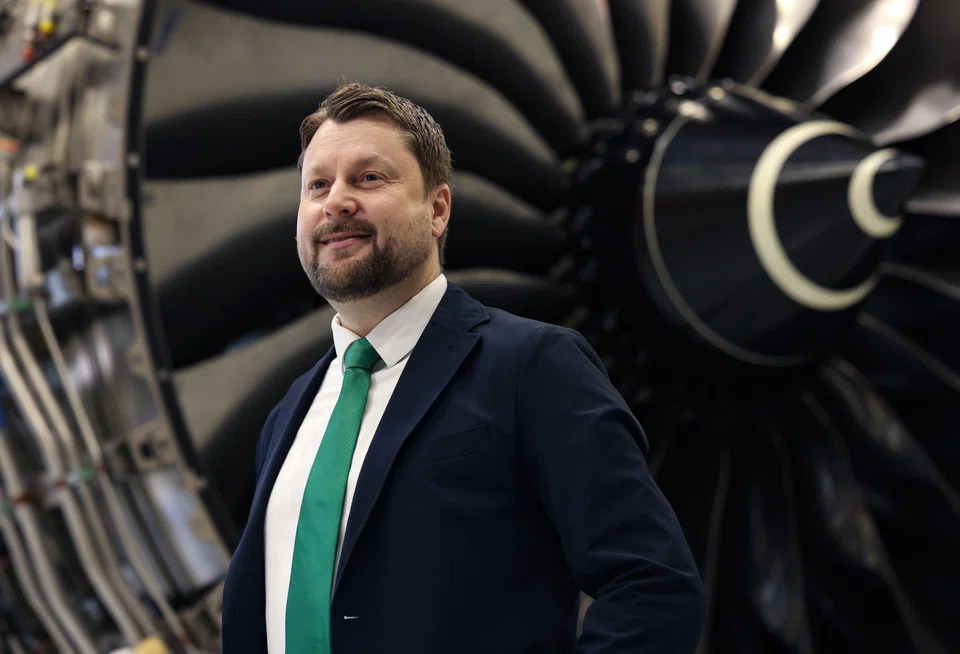
(Photo credit: Yen Meng Jin, BT)
Source: The Business Times
If you have ever taken a wide-body jet from either Boeing or Airbus that is powered by a Trent engine, the chances are very high that the most visible part of the engine is manufactured in Singapore.
Rolls-Royce’s facility in the Seletar aerospace park district in the city-state’s north-east is responsible for churning out about 90 per cent of all the fan blades that the British manufacturer makes annually for its civil jet engines.
“We manufacture about 5,000 individual fan blades currently. That number is set to grow significantly over the next few years as our Trent engine base operating with key airlines around the world continues to grow,” Rolls-Royce’s senior vice-president for Asia-Pacific and civil aerospace John Kelly told The Business Times.
Rolls-Royce’s manufacturing in Singapore is part of a globalised ecosystem of civil aviation manufacturing.
These fan blades made here are then shipped back to the United Kingdom, where Rolls Royce is headquartered, to be assembled into the engine.
The 5,000 or so fan blades made in Singapore roughly translates to about 700 engine sets that go into both the production of brand new engines or into the maintenance of engines that require support and new fan blades over time.
The facility in Seletar was commissioned in 2012, but the British manufacturer’s presence in the Republic goes back decades both in civil aviation and in the defence industry.
Singapore has served as a regional hub for maintenance, repair and overhaul, and for customer-related services on the civil aviation side. For the defence industry, Rolls-Royce Power Systems has provided power-based applications that go into tanks or ships.
“Singapore may be small geographically, but it’s certainly not small in terms of its significance. We’re very proud of the fact that we manufacture in Singapore,” Kelly said.
He said that part of the reason the company has expanded into aviation manufacturing in Singapore was due to its partnership with government entities that are open to engaging in research and development together with it.
According to Rolls-Royce’s 2024 annual report, the British manufacturer employs around 700 people in Singapore, and the city-state’s operations accounted for 2.7 per cent of its £18.9 billion (S$33 billion) annual revenue.
Civil aviation industry in Singapore
Rolls-Royce is not the only global aviation manufacturer with a significant footprint in the city-state. Other industry giants such as Thales and Pratt & Whitney also have extensive operations in Singapore.
“Singapore serves as Thales’ regional aviation hub in Asia, providing proximity to fast-growing airline markets and global OEM (original equipment manufacturer) partners,” Kee Sau Chew, Thales’ industrial director of Avionics Asia Pacific Industrial Center, told BT.
The French aerospace company has a five-decade presence in Singapore, and like Rolls-Royce, expanded from doing maintenance, repair and overhauls to manufacturing in Singapore.
Thales’ Singapore teams focus on high-volume avionics manufacturing, producing about 11,000 units annually. These include flight control computers and displays for the Airbus A320, A330 and A350 families.
According to the latest data from Singapore’s Economic Development Board, transport engineering was one of the faster-growing sectors in December.
Output for transport engineering grew 20 per cent year on year in December, with the aerospace segment expanding 35.9 per cent, supported by higher production of aircraft parts and sustained maintenance, repair and overhaul jobs from commercial airlines.
The aerospace industry is responsible for about 20,000 jobs in Singapore. Manufacturing, as a whole, remains a core pillar of Singapore’s economy, contributing about 20 per cent to its gross domestic product.
The aerospace industry is one that the government has been trying to build since the 1960s following Singapore’s independence and the subsequent withdrawal of the British military.
The country’s flagship carrier, Singapore Airlines, was incorporated in 1972. An engineering division was later set up to support maintenance and repair works and this engineering arm went on to become SIA Engineering Company.
Civil aviation infrastructure
At the same time as Singapore built up its civil aviation infrastructure, ST Aerospace, now ST Engineering Aerospace, was founded in 1975 and developed defence-linked maintenance capabilities to support the country’s air force.
ST Engineering Aerospace subsequently branched out into the commercial sector to support airlines from its Singapore base, and later expanded overseas for global reach.
Joshua Ng, a director at Alton Aviation Consultancy, explained these developments, particularly that of SIA Engineering Company and ST Engineering Aerospace helping to anchor Singapore’s maintenance, repair and overhaul capabilities.
Currently about 10 per cent of commercial aviation maintenance, repair and overhaul is done in Singapore.
Yet Ng also noted that attracting companies to have manufacturing capacity in the city-state is necessary for Singapore to remain competitive as it becomes a higher-cost country.
Manufacturing also allows the city-state to diversify its aviation operations as maintenance work is tied to fleet operations and utilisation cycles, while manufacturing is tied to aircraft and engine production cycles.
“Singapore focuses on the precision manufacturing of aircraft and engine components; these are high-value parts of the aircraft and require the workforce to have strong technical skills,” he said.
He added that precision manufacturing also has higher value-add, thus increasing the value-add per employee and value-add per area, which are important factors in land and labour-constrained Singapore.
For Kelly from Rolls-Royce, the evolution and investments from the British manufacturer made sense as Singapore’s aviation industry grew.
He highlighted the upcoming new airport terminal, which could further boost connectivity and air traffic, as the latest sign of the government’s desire to grow the industry.
“The business environment in Singapore is very positive. We have a stable area, politically and security-wise and the right infrastructure. So in terms of cost of operation, when you factor in all the key elements, it more than offsets some of the extra costs and certainly makes sense for us as an economic venture here in Singapore,” he added.