
Singapore Airshow draws record 65,000 trade visitors in 4 days; next run set for Feb 15-20, 2028
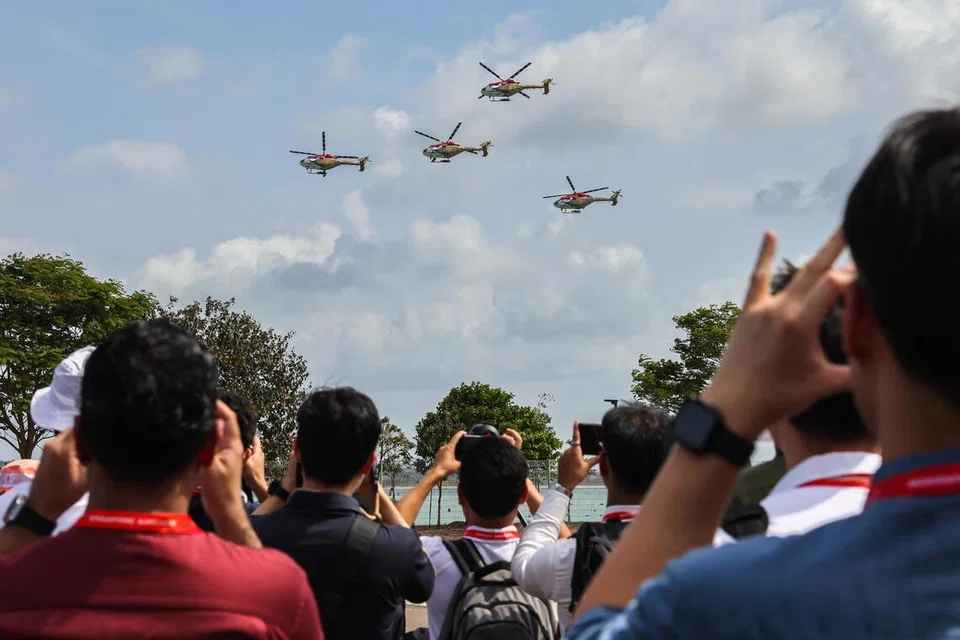
(Photo credit: ST Photo/Gin Tay)
Source: The Straits Times
Some 65,000 trade visitors attended the first four days of the Singapore Airshow, an all-time high, said organiser Experia Events, as South-east Asia continues to be one of the world’s fastest-growing aviation sectors.
The record attendance reflected “the strength and resilience of the aerospace and defence sector”, said Experia managing director Leck Chet Lam on Feb 6, marking the end of the show’s four-day trade segment.
The trade attendees hailed from more than 130 countries and regions, and over 1,100 companies participated in the air show, said Experia.
In 2024, the event attracted nearly 60,000 visitors to the four-day trade show and about 110,000 visitors overall, including the two public days, said Mr Leck.
The 10th edition of the biennial aerospace and defence exhibition will open to the public on Feb 7 and 8.
The next air show is scheduled for Feb 15 to 20, 2028.
The 2026 show centred on themes such as artificial intelligence (AI) in aviation, sustainability and advanced air mobility.
While sustainability is not a new topic, Mr Leck noted that interest in it is gathering steam, reflected in the level of engagement at the event.
He cited the inaugural Space Summit, introduced in 2026, as another example of how the show is evolving, adding that it drew more than 2,000 attendees and more than 300 participating companies and organisations. The Space Summit will be an annual affair, with the next edition scheduled for Feb 25 and 26, 2027.
The 2026 air show takes place as surging air travel demand is set to drive strong growth in Asia-Pacific’s aviation sector over the next two decades.
European jetmaker Airbus projects the aviation services market in the Asia-Pacific region will reach US$138.7 billion (S$176.6 billion) by 2044, with passenger traffic growing 4.4 per cent a year, above the global average of 3.6 per cent. Airlines are expected to need 19,560 new passenger aircraft, accounting for 46 per cent of global demand.
Boeing said South-east Asia, in particular, will be among the world’s fastest-growing aviation markets, with passenger air traffic expected to grow by 7 per cent a year through 2044.
To keep up, airlines in the region will need 4,885 new aircraft over the next 20 years, as well as about 243,000 additional aviation workers. This includes roughly 62,000 pilots, 103,000 cabin crew and 78,000 technicians, said the American plane maker.
The large youth population and swelling middle class in ASEAN are a lucrative market for the aviation sector to tap into, said Mr Subhas Menon, the outgoing director-general of the Association of Asia Pacific Airlines.
“Airlines have to take things into their own hands and find different creative solutions to address the opportunities that are there,” he said, noting that the Asia-Pacific region should explore developing maintenance, repair and overhaul capabilities of its own to alleviate the supply chain issues dogging the industry.
AI in aviation
The topic of AI drew renewed interest this year.
At a panel discussion on Feb 5, Mr David So, senior vice-president for base maintenance at SIA Engineering Company, said AI is used to draw insights from decades of data in the company to prepare resources and replan workflows for the checking of aircraft.
While the company has been working on the use of machine vision for keeping track of its inventory, Mr So said there is also potential for the technology to be used to assist in aircraft inspection.
For ground handler and in-flight caterer Sats, AI is used for optimisation, said the company’s chief digital officer Sandeep Sakharkar, citing the example of its use in the efficient deployment of staff.
While AI has changed the aviation worker’s role significantly, Boeing’s chief technology officer, Dr Todd Citron, said that it will not replace the need for human intervention.
He said: “Very quickly, (AI) is going to change the role of the human in the design process. So it won’t eliminate the person; the person is still really critical. But what they do is going to be very different, because machines can iterate much more quickly than humans, but the human input is still required.”
For example, AI could be used to generate a certification plan for an aircraft based on the past experience of the company, which could then be given to an engineer to check for accuracy, Dr Citron said.
Sustainability in the spotlight
Sustainable aviation fuel (SAF) was a major focus at the show, with at least two panels dedicated to the topic.
Made mostly from waste materials such as used cooking oil, SAF is seen as the most practical way to decarbonise aviation. It can be blended with traditional jet fuel and used in existing aircraft and refuelling systems without costly modifications. SAF is projected to account for 40 per cent to 60 per cent of the industry’s decarbonisation by 2050.
Despite sufficient production capacity, demand remains limited, said Mr Julien Manhes, head of sustainable aviation fuel and carbon dioxide removals at Airbus. With SAF costing three to four times more than conventional jet fuel, adoption has been slow.
Mr Manhes welcomed the industry’s mobilisation on climate change, but warned against regulatory fragmentation. “Everybody needs to slowly and progressively get into sustainability, into regulatory schemes that allow that transition,” he said.
At a Feb 5 panel discussion, Mr Ed Mason, chief executive of Australian SAF producer Jet Zero, stressed the importance of supply chain transparency to build corporate confidence. “As a producer, we have to do a lot more to market the fuel,” he said.
Singapore, as a major aviation hub, is well-placed to lead regional decarbonisation with SAF producer Neste and national carrier Singapore Airlines, which already uses SAF, Mr Manhes said.
In 2025, Singapore established the Singapore Sustainable Aviation Fuel Company (SAFCo) to manage SAF supplies for the country’s airports. SAFCo plans to use a passenger levy to fund the purchase of green jet fuel, aiming for SAF to make up 1 per cent of jet fuel at Changi and Seletar airports in 2026, rising to 3 per cent to 5 per cent by 2030.
The Asia-Pacific presents a huge opportunity, Mr Manhes added. “Asia is home to the feedstock – the raw material for SAF. It’s a chance for the region to develop a new industry and become the SAF powerhouse for the world.”
Advanced air mobility
Operations for electric vertical take-off and landing (eVTOL) vehicles – or air taxis – are still costly because of the lack of mass production, expensive insurance plans and high certification costs, according to the Asia-Pacific advanced air mobility report 2025 by aviation consultancy Asian Sky Group (ASG).
Unveiling research findings on Feb 4 at the air show, Mr Jersey Wu, director of business development at ASG’s parent company Avion Pacific, said air taxis should ideally be one-eighth the cost of a traditional helicopter, but that has not happened yet.
He added that for prices to go down, these vehicles also need to do away with their pilots and be flown autonomously, so that earnings can be maximised from each air taxi ride, but this is not possible yet as aviation authorities have strict regulations for the eVTOL sector.
Having conducted research on 48 air taxi models released in or before 2025 by 43 eVTOL manufacturers in the region, Mr Wu said there are still operational restrictions in China, for instance – including a mandate requiring air taxis to land only at spots from which they took off, and a ban on flights over densely populated areas.
He expects costs to decline when the vehicles eventually tap into economies of scale as markets develop, perhaps through government subsidies.
Noting that regulations in China may make it tough to start air taxi operations, Mr Wu said many Chinese eVTOL manufacturers are looking to expand to the Middle East or South-east Asia.
The accelerating momentum for the development of air taxis was evident in the deals made at the air show. British-based Vertical Aerospace is partnering Japanese trading and investment firm Marubeni Corporation to plan an air taxi network across Japan and kickstart plans for piloted demonstration flights in the Osaka Bay area in 2026.
Also inked at the show was an order for two air taxis from Embraer subsidiary Eve Air Mobility, with options for 48 more, by Japanese air charter platform AirX for sightseeing and short trips across Japan.