
Real median income in Singapore rose 4.3% in 2025 as workers in permanent jobs hit new high
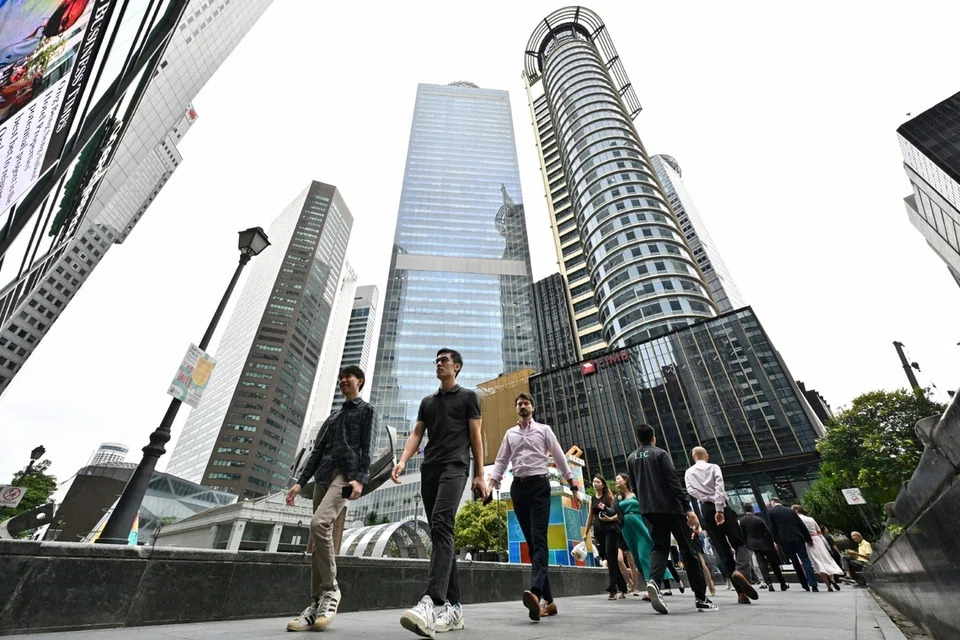
(Photo credit: ST Photo/Lim Yaohui)
Source: The Straits Times
Singapore workers saw their incomes grow in 2025 after taking lower inflation into account, while the proportion of the workforce in permanent jobs hit a high of over 90 per cent, according to data released by the Ministry of Manpower (MOM) on Nov 28.
These trends indicate that Singapore’s labour market is stable despite a more uncertain external environment, it added.
Real incomes rose 4.3 per cent for resident workers at the median wage level. Residents refer to those who are either citizens or permanent residents here.
Lower-wage earners also saw greater strides in their pay. Real incomes rose 3.8 per cent for those at the bottom 20 per cent threshold, MOM’s preliminary labour force data showed.
These figures are preliminary as full-year inflation data is not yet available for 2025.
Real income growth exceeded the past decade’s annual averages of 2.9 per cent for those at the 20th-percentile level, and 2.1 per cent for those at the median salary, Mr Ang Boon Heng, MOM director, manpower research and statistics department, said at a media briefing on Nov 26.
The 4.3 per cent growth in real median income in 2025 was more than the 3.2 per cent rise in 2024, due in part to Singapore’s inflation continuing to ease this year.
For 2024 as a whole, core inflation averaged 2.7 per cent, while the official forecast for 2025 is 0.5 per cent. With continued nominal income growth and inflation easing, real incomes grew in 2025, higher than the growth seen over the past decade.
As for nominal income growth – that is, before accounting for inflation – the median wage rose 5 per cent to $5,775 in 2025, from $5,500. For 20th-percentile earners, it rose 4.6 per cent to $3,164, from $3,026 in 2024.
Apart from easing inflation, the growth in real incomes came as the proportion of workers in permanent jobs rose to a new high of 90.8 per cent. This increase was observed in most industries, including growth sectors such as professional services, health and social services, as well as information and communications. “This gives the sense that they are in quality-type of jobs that are relatively more stable,” said Mr Ang.
An MOM spokesperson said this stability also means employees “do not have to worry that their job will come to an end tomorrow”.
Labour under-utilisation – which looks at both the unemployed and under-employed – remained low in 2025.
This includes time-related under-employment – which refers to part-timers who want to do additional work but are unable to find work – with the rate falling from 2.3 per cent in 2023 and 2024, to 1.9 per cent in 2025. This figure was lower than a decade ago, when it stood at 2.9 per cent.
Resident unemployment rates for both PMET (professionals, managers, executives and technicians) and non-PMET jobs stayed stable and low at 2.8 per cent, while long-term unemployment declined further for both groups.
The number of discouraged workers, which refers to people who gave up on their job search, also remained low at 7,400.
“Together, these indicators suggest that labour market conditions remain firm even as hiring momentum moderates,” said MOM.
Singapore’s labour force participation rate remains largely stable despite its ageing population. It declined slightly for the fourth consecutive year, down from 70.5 per cent in 2021 to 67.9 per cent in 2025.
Despite the slight dip, Singapore’s rate continues to rank among the highest across Organisation for Economic Cooperation and Development countries such as Iceland, Sweden and New Zealand, MOM noted.
The employment rate among “prime-age” residents aged 25 to 54 fell slightly from 87.7 per cent in 2024 to 87.5 per cent in 2025.
MOM said the decrease stems from the hiring slowdown in outward-oriented sectors like information and communications, wholesale trade, professional services, manufacturing, and financial and insurance services. These are some of the top sectors prime-age residents are employed in.
Mr Musa Fazal, chief policy and operating officer for advocacy and policy at Singapore Business Federation (SBF), said that while business confidence has dipped and the outlook remains cautious, SBF’s just-released annual survey showed that a sizeable number of businesses (26 per cent, or about three in 10) said they plan to increase the number of employees over the next 12 months, with only a small fraction (11 per cent, or about one in 10) planning to reduce the number of employees.
“The vast majority plan to freeze hiring, reflecting the cautious outlook ahead,” he noted.
MOM’s data showed that, except for those aged 15 to 24 who chose education or training over work, the employment rate across age groups in the last decade has been on a broad uptrend, with a marked improvement seen for seniors aged 65 and above.
Ms Jessica Zhang, senior vice-president, Asia-Pacific, of human resources and payroll solutions provider ADP, said younger workers aged 18 to 26 showed the highest uncertainty about the impact of artificial intelligence on their jobs, reflecting a clear awareness that job requirements are evolving, and that training is a practical way to stay competitive.
Entry-level expectations have also shifted, she added, with employers now placing greater emphasis on skills.
The findings in the 2025 advance labour force report are drawn from the annual Comprehensive Labour Force Survey, which covers a representative sample of more than 33,000 resident households.