
Over 8,000 internships, industry attachments created to support fast-growing data centre capabilities
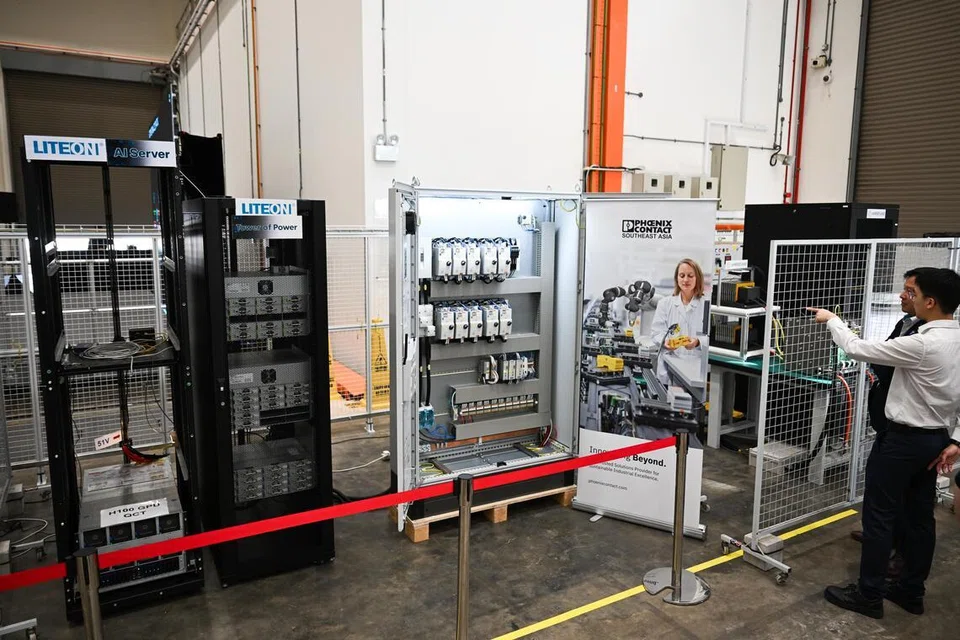
(Photo credit: ST PHOTO/SHINTARO TAY)
Source: The Straits Times
More than 8,000 internships, training opportunities and industry attachment openings have been developed in the data centre sector, as part of a national push to build artificial intelligence-ready capabilities.
Over the next five years, data centre provider ST Telemedia Global Data Centres (STT GDC) will provide internship placements across the Institute of Technical Education (ITE), Singapore Polytechnic (SP), Nanyang Technological University (NTU) and National University of Singapore (NUS).
Through this initiative, young entrants will benefit from hands-on experience in data centre operations and corporate functions such as information technology, sustainability, finance and marketing.
Over three years, about 800 ITE students annually will also benefit from initiatives like the deployment of a data centre virtual reality system for immersive training.
The initiative was announced on Jan 26 by data centre provider STT GDC, which also signed a memorandum of understanding with the four institutes of higher learning to expand early career pathways for Singaporeans entering the workforce.
These initiatives align with national efforts to support fresh graduates in a challenging job market, said STT GDC in a press statement.
At the same event, STT GDC also announced the launch of the FutureGrid Accelerator, a platform that demonstrates how high-voltage direct current (HVDC) can enable more sustainable use of energy with higher efficiency and stronger resilience for artificial intelligence (AI) computing needs. It is the region’s first live test bed demonstrating this technology, said STT GDC.
The platform is located at the Electrification and Power Grids Centre on Jurong Island, which is owned by Energy Research Institute @ NTU (ERI@N).
Data centres that power AI computing are huge energy guzzlers. The International Energy Agency projects that electricity demand from data centres worldwide is set to more than double by 2030 to around 945 terawatt-hours, slightly more than the entire electricity consumption of Japan today.
ERI@N is the only facility in Singapore – and one of the first in South-east Asia – dealing with medium voltage, said its executive director, Professor Madhavi Srinivasan.
She noted that as AI and energy is a very new topic, talent needs to be trained. “Interested students can be part of this facility for their internship,” she said.
She added: “This facility is very important because when we talk about energy research, there are new technologies that are coming out of the lab. But before it can go into commercialisation, we need to test them in a real-world scenario, and that’s what this facility helps to do.”
ITE chief executive Peter Lam said Singapore is seeing rapid growth in both its data centre industry and electrification. But there is a dearth of talent in these areas, he noted, where awareness is “not there yet”.
He told The Straits Times that while electrical engineering is one of the main courses that contribute to the data centre industry, students trained in engineering, sustainability, data science, data engineering and IT can also consider pathways in the sector.
“If you’re trained as an engineer, the structured way of problem-solving and foundational skills will enable you to take on other roles within this industry as well. Because today, the data centre industry is actually quite rocket science, and you don’t need just electrical engineers.
“You also need mechanical engineers for many mechanical systems that operate within the data centres, like cooling systems.”
Meanwhile, data engineers and data scientists will be able to process data, figure out what it means and translate it into engineering solutions to make sure a data centre is run more efficiently or designed in a better way, he added.
New high-voltage direct current technology
“As we move more towards HVDC systems, there’s a need for us to have more teaching materials or new subjects in this area,” added Mr Lam. The current electrical engineering course primarily focuses on the alternating current system.
The traditional power infrastructure – the alternating current ecosystem – results in significant power losses because of multiple power conversion steps. The new HVDC technology, however, results in a 30 per cent increase in overall energy savings and avoids inefficient power conversions.
Said STT GDC country head in Singapore Lim Mingcheng: “There’s a lot of power required in one single rack in a data centre. And because of that, the traditional alternating current systems cannot support this kind of workload sustainably. That’s why we have to look at rethinking how to support these AI server racks down the road.
“We want to test it in Singapore, and then down the road, bring it out and deploy it commercially within Singapore, and given that (STT GDC is) in 12 countries – six within South-east Asia – we also hope to deploy beyond the region.”
Referring to the FutureGrid Accelerator, STT GDC president and group chief executive Bruno Lopez said: “Importantly, this isn’t just a one-time demonstration; it’s a working test bed where, together with our partners and broader industry, we will test and refine HVDC electrical systems to develop new standards using real AI servers.
“It represents a bold step towards building infrastructure that can keep pace with AI’s rapidly accelerating demands, while supporting Singapore’s ambition to remain a trusted world-class hub for digital innovation.”