
2025 another record year for S’pore’s port as containers handled, vessel arrivals hit new highs
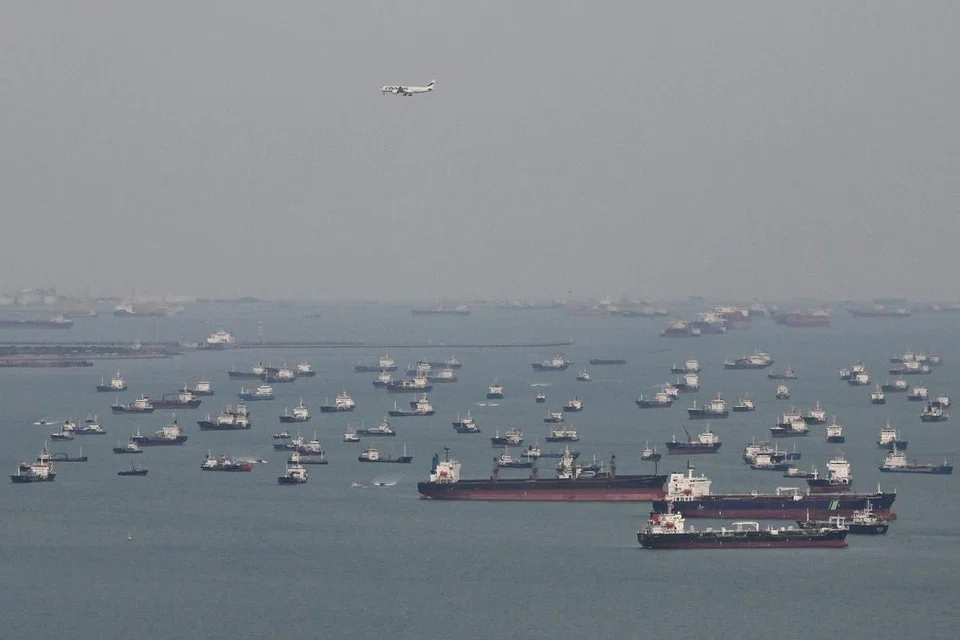
(Photo credit: ST Photo/Lim Yaohui)
Source: The Straits Times
Singapore’s port handled 44.66 million shipping containers, or twenty-foot equivalent units (TEUs), in 2025 – its highest on record – eclipsing the 41.12 million in the previous year.
This is an 8.6 per cent increase in the number of TEUs handled – the maritime industry’s standard gauge for container traffic – from 2024, said the Maritime and Port Authority of Singapore (MPA) on Jan 13.
Ship arrivals also reached a new peak, with annual vessel arrivals climbing to 3.22 billion gross tonnage, up 3.5 per cent from the 3.11 billion gross tonnage registered a year earlier.
Gross tonnage represents the combined internal volume of all ships in a year, including their engine room and non-cargo spaces.
It is a common maritime industry measure of vessel traffic calling at a port.
These figures underscore the Republic’s “enduring role as a choice port of call”, and its position as a global maritime and trade hub, Senior Minister of State for Law and Transport Murali Pillai said at the Singapore Maritime Foundation New Year Conversations.
The yearly maritime industry event was held at the Parkroyal Collection Marina Bay hotel.
Even so, Mr Murali cautioned that “as we enter 2026, our external environment remains challenging, with continued uncertainty from geopolitical tensions, changing tariffs and threats of supply chain disruption”.
But despite these pressures, global seaborne trade is expected to grow, and Mr Murali expressed his confidence that Singapore’s maritime sector will continue to thrive.
While record highs were reached on several fronts, the amount of cargo handled by Singapore’s port fell 1.4 per cent, from 622.67 million tonnes in 2024 to 614.34 million tonnes in 2025.
The figure remained below the pre-pandemic level of 626.52 million tonnes recorded in 2019.
A dip in the amount of cargo handled in 2025 despite a record number of containers suggests that while more containers came to Singapore, they carried lighter or less cargo.
Explaining further, Associate Professor Yap Wei Yim, head of the maritime management minor at the Singapore University of Social Sciences, said the country’s port typically performs well during times of disruption, especially in terms of the number of containers it handles.
But because of these uncertainties, demand for certain types of cargo, such as oil, may be reduced, resulting in less cargo.
In 2025, total bunker sales, referring to the fuel supplied to ships, hit a new high of 56.77 million tonnes, with alternative fuels recording strong momentum.
The sale of such fuels climbed from 1.35 million tonnes in 2024 to 1.95 million tonnes in 2025, largely driven by biofuel blends.
Such blends combine conventional marine fuel with biofuel derived from biomass, such as agricultural biowaste, or organic material generated from agricultural production. MPA said 1.38 million tonnes of biofuel blends were sold in 2025, up from 0.88 million tonne the previous year.
Liquefied natural gas (LNG), which is widely viewed as a transitional fuel to net-zero carbon emissions, saw more modest gains in sales, increasing from 0.46 million tonne to 0.57 million tonne.
Methanol, despite forming only a small percentage of alternative marine fuels, recorded the highest growth rate – with sales almost doubling from 1,626 tonnes in 2024 to 3,013 tonnes in 2025.
Although alternative fuels currently make up a small part of total bunker sales, Prof Yap expects their momentum to continue growing.
“Some firms are taking a wait-and-see approach because of the current geopolitical climate,” he said, citing how the US threatened measures against countries supporting a net-zero framework proposal by the International Maritime Organization in August 2025.
As a result of the threats, the proposal was pushed back by a year in October 2025, but Prof Yap believes that there will be a sudden rush to tap alternative fuels eventually.
Over the year, 35 maritime companies and start-ups started or expanded operations in Singapore, out of more than 200 international shipping groups operating in the country.
Key maritime companies spent a total of about $5 billion in 2025. In 2024, this figure was $5.2 billion, and in 2023, $4.8 billion.
Looking ahead, Mr Murali stressed that Singapore must seize opportunities by tapping key trends that are influencing the sector, namely digitalisation and decarbonisation.
On the digital front, MPA is working with Microsoft and Amazon Web Services on a slew of technological developments, including artificial intelligence and cloud computing, to improve operations and support the upskilling of workers, among other things.
The authority has also rolled out AI to carry out administrative functions, such as the issuance of ship insurance certificates, with plans to digitalise other functions in 2026.
In terms of decarbonisation, Mr Murali said the MPA is leading efforts to develop Singapore into a multi-fuel bunkering hub.
He cited how it will on Jan 14 open applications for additional licences to supply LNG as marine fuel to better fulfil growing industry demand, and launch a set of standards covering the equipment, operational performance and efficiency of LNG bunker vessels operating in Singapore.
In the second quarter of 2026, MPA and trade agency Enterprise Singapore are also expected to upgrade the Technical Reference for LNG Bunkering into a Singapore Standard.
Such technical references are developed to address urgent industry needs, according to information on the Enterprise Singapore website, and can be elevated to the status of a national standard after a review.
This will strengthen the requirements for “safe, transparent and quality-assured LNG bunkering” in Singapore, noted Mr Murali.